Showing posts with label Denmark. Show all posts

February 2, 2022

Head of Danish military intelligence arrested but independent inquiry finds no wrongdoing

(Updated: November 13, 2023)

Unprecedented developments in Denmark: a former defense minister as well as the head of the military intelligence service FE have been charged for disclosing highly classified information, for which the latter has even been imprisoned.

Here I will provide more details about the arrest of FE head Lars Findsen and the charges against defense minister Claus Hjort Frederiksen, followed by a summary of how the crisis has developed, the recent conclusions of an independent investigation and finally the similarities to the Snowden case.
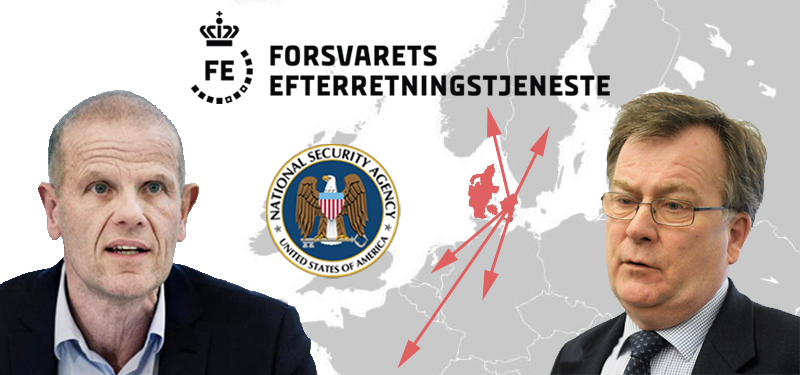

FE head Lars Findsen (left) and former defense minister Claus Hjort Frederiksen
(photos: Liselotte Sabroe/EPA-EFE & Johannes Jansson/Norden)


FE head Lars Findsen arrested and imprisoned

On January 10, the Danish broadcaster DR reported that Lars Findsen had been arrested on Copenhagen Airport on December 8, 2021, after he had been under surveillance by the Danish police intelligence service (Politiets EfterretningsTjeneste or PET).

It's a wry turn of fate as Findsen himself had been the head of the PET from 2002 to 2007. Since 2015 he led the Danish military intelligence service (Forsvarets Efterretningstjeneste or FE), before he was suspended in August 2020.

Update:
On April 4, 2022, DR reported that the PET had apparently bugged Findsen's house in order to find out whether he revealed classified information to family members, which is a very intrusive method that is only used in the most serious cases.

According to DR, the PET set up a special investigation after on September 30, 2020 the Danish newspaper Berlingske published a long piece with unprecedented details about the cooperation between the FE and the NSA. The investigation intensified when in May 2021 news media from several European countries provided additional details based upon nine sources with access to classified information (see below).

On the same day as Lars Findsen, the PET arrested three other current and former employees of the FE and the PET. Just like Findsen, they are accused of the unauthorized disclosure of highly classified information in violation of section 109(1) of the Danish criminal code, which is punishable with up to 12 years in prison.

This came quite unexpected because section 109 was only used once before, as it is meant for cases of treason and espionage, comparable to the American Espionage Act of 1917. In Denmark, leaks by government employees were usually charged under a much less strict law which can lead to imprisonment for only up to two years.


The headquarters of the Danish police intelligence service PET


The exact charges against Findsen haven't been made public, but according to DR News it's about leaking information to the press. Just before a hearing behind closed doors at Copenhagen magistrate's court on January 10, Findsen exclaimed to the press: "I want the charges brought forward and I plead not guilty. This is completely insane". Findsen has to stay in prison at least until February 4, the other three have been released on bail.
Updates:

On February 4, the court gathered behind closed doors again and decided that Findsen has to stay in custody for another four weeks. Highly unusual was the fact that it took some 8 hours to reach that decision. Findsen appeared in court carrying the 2017 war novel All the Light We Cannot See by Anthony Doerr.

On February 17, an appeals court ordered that Findsen had to be released from prison because although there's "a well-founded suspicion" that he violated Danish law by disclosing intelligence information, the court "didn’t find that the conditions for a pre-trial detention are met."

Already in December 2021, the head of the PET and the acting head of the FE visited the main Danish media outlets and warned that their editors could also be charged under section 109. On January 4, eight journalists from six media were summoned for questioning as part of the police investigation into the leaks about the FE.

A possible explanation for this intimidation could be that the Danish government wants to demonstrate that they will punish leakers severely and do everything to prevent any further leaks in an attempt to comfort the FE's foreign partners, especially the Americans, who are likely highly disturbed by the recent developments.

This could risk the continuation of the intelligence cooperation, for which mutual trust is the most important factor: intelligence agencies will only be willing to share their secret information when they are convinced that the other side will keep the information just as secret and will not misuse it in any way.


Lars Findsen in his office as head of the FE, with two Cisco 7900-series IP phones,
apparently one for secure and one for non-secure calls
(photo: Ritzau/Jens Dresling - click to enlarge)


Charges against former Defense minister Frederiksen

The current crisis didn't stop at the imprisonment of Lars Findsen though: on January 14, it was reported that Claus Hjort Frederiksen, who was defense minister from November 2016 to June 2019, is also charged under section 109. This was made public in a brief press release which the Liberal or Venstre Party sent to Danish media.

As a member of parliament, Frederiksen has immunity, but the Liberal Alliance party doesn't want to lift it unless the Danish parliament gets full insight into a possible criminal case against him. In the press release he said that he never had the intention to harm Denmark or Danish interests.
Update:
On February 4, 2022, Frederiksen issued a statement on Facebook in which he said that the day before he got insight into the charges against him and that they are only based on newspaper articles and public debates.

During two interviews in December 2021 (with the television programs Deadline and Lippert), Frederiksen had been remarkably talkative about the FE's cooperation with the NSA, but he was also angry about how his successor as defense minister, Trine Bramsen, handled the case by suspending Findsen and some other officials, including a general responsible for the relations with the Americans.

Just recently it was revealed that on February 28, 2019, Frederiksen had arranged a meeting with the Oversight Board to convince them to drop their investigation into the FE in order to not endanger the cooperation with the NSA - a controversial move given the independent position of the Oversight Board, which accordingly continued its investigation that eventually sparked the current intelligence crisis.


Current Danish defense minister Trine Bramsen (left) and her predecessor
Claus Hjort Frederiksen (photo: Linda Kastrup/Scanpix)


After the revelations in the media, Frederiksen apparently felt free to explain and stress that the FE did nothing wrong: that spying on European countries is common practice and that to protect Danish citizens (i.e. to keep within the law) the FE had installed filter systems.

He was especially concerned about the relationship with the NSA, because in recent years, Denmark had reached almost the same level as the Five Eyes partnership, an achievement that his successor had put at risk now, according to Frederiksen.

There are actually several countries that claim a position very close to the Five Eyes, but fact is that Denmark is a so-called Third Party partner of the NSA already since 1954 and, as such, a member of the SIGINT Seniors Europe (SSEUR) and, between 2009 and 2014, of the Afghanistan SIGINT Coalition (AFSC).


Development of the intelligence crisis

The Danish intelligence crisis started on August 24, 2020, when the ministry of Defense issued a short statement saying that Lars Findsen and two other officials of the military intelligence service had been suspended from duty until further notice.

The same day, the Intelligence Oversight Board (Tilsynet med EfterretningsTjenesterne or TET) issued a press release with the unclassified results of an investigation that had been initiated by information provided by one or more whistleblowers. The main accusations were:
- The FE withheld key and crucial information and provided the Oversight Board with incorrect information;
- There were risks that the FE's collection activities led to unlawful collection against Danish citizens;
- The FE failed to investigate indications of espionage within the Ministry of Defense;
- There's a culture of insufficient legal awareness within the FE's management;
- There were activities in violation of the Danish law, including obtaining and sharing information about Danish citizens;
- The FE has unlawfully processed information about an employee of the Oversight Board.

On December 21, 2020 the Danish justice minister established the FE Commission (FE-kommissionen) to further investigate the allegations against the FE and to present a report within a year.


The Kastellet fortress in Copenhagen, the workplace of most of the FE's employees
(photo: Danish Air Force Photo Service)


The FE uses XKEYSCORE to process data from the cable tap

Meanwhile, Danish media came with unprecedented disclosures: on September 13, the newspaper Berlingske revealed how in the mid-1990s the FE, in cooperation with the NSA, started to tap a backbone cable containing communications from countries like China and Russia - very similar to Operation Eikonal (2004-2008) in which the NSA cooperated with the German foreign intelligence servce BND.

According to Berlingske, the communications of interest were extracted from the cable in Copenhagen and were then sent to the Sandagergård complex of the FE on the island of Amager. Part of the agreement between the US and Denmark was that "the USA does not use the system against Danish citizens and companies. And the other way around".

On September 24, 2020, the Danish broadcaster DR reported that after 2008, NSA employees traveled to Denmark to build a data center for a new system to process the data from the cable tap. The heart of this system is formed by XKEYSCORE, the sophisticated processing and filtering system for internet data used by the NSA and GCHQ.


The Sandagergård complex of the FE on the island of Amager,
where a data center was built specifically to store data
from the joint NSA-FE cable tapping operation.
(Click to enlarge)


According to DR News, the FE tried to develop a number of filters to ensure that data from Danish citizens and companies is sorted out and not available for searches. Former defense minister Frederiksen confirmed the existence of such filters, but also admitted that there can be no 100% guarantee that no Danish information will pass through.

Berlingske had also identified the whistleblower as a young IT specialist of the FE, who in 2013 became increasingly concerned, after which then head of the FE Thomas Ahrenkiel ordered an internal investigation, which found no signs of abuse by the NSA. The IT specialist, however, was not satisfied with this result and informed the intelligence oversight board somewhere in 2018 and provided them with new information in November 2019.


The NSA tried to spy on Danish and other European targets

On November 15, 2020, the Danish broadcaster DR published a story about two internal assessments from the FE, one from 2012 and another one from 2015 (or 2014?), which contain an analysis of the phone numbers and e-mail addresses (also known as selectors) which the NSA sent to the FE for collecting information from the cable tap.
- According to the analysis from 2012, the NSA submitted selectors for Danish targets, including the ministry of Foreign Affairs and the ministry of Finance, as well as the Danish defense company Terma.

- The 2015 analysis of selectors showed that the NSA also used the cable tapping cooperation to spy on targets in European countries like Sweden, Norway, the Netherlands, Germany and France, according to DR News.
On May 30, 2021, joint reporting by DR, SVT, NRK, Süddeutsche Zeitung, NDR, WDR and Le Monde revealed that the internal investigation which FE boss Ahrenkiel initiated in 2014 was codenamed Operation Dunhammer and concluded in May 2015 that the NSA had provided telephone selectors for Norwegian, Swedish, German, Dutch and French politicians and officials, including former German chancellor Angela Merkel and then foreign minister Frank-Walter Steinmeier.


This outcome is actually not very surprising, because from the German parliamentary investigation (2014-2017) into the cooperation between the NSA and the BND it also became clear that, among hundreds of thousands of identifiers for legitimate targets, the NSA had provided the BND with thousands of selectors related to European and even German targets, which in 2015 resulted in the "Selector Affair".


The FE Commission finds no wrongdoing

On December 13, 2021, the independent FE Commission finally presented its report about the accusations against the FE. Surprisingly, the commission found no evidence of wrongdoing by the FE and also found no basis to hold the former and current head of the FE, Ahrenkiel and Findsen, accountable.

The report from the FE Commission is classified, but its conclusion have been published on the commission's website. Because they are only available in Danish, I made a preliminary translation using Google Translate with some manual corrections, which can be found here.

Focusing on the most important accusations, the commission found no evidence that the FE provided incorrect information to the subsequent defense ministers nor to the Intelligence Oversight Board. The commission also found no basis for assuming that the FE has generally obtained and passed on information about Danish citizens in violation of the law.

Given everything that emerged from the various revelations by Danish media this conclusion came as a surprise, but it can probably be explained by the fact that spying on other European governments is not prohibited by Danish law, how embarrassing it may be when it becomes public.

And if the FE has a similar filter system as used by the German BND, then the Danish selectors which the NSA provided to the FE would have been blocked before they were entered into the actual collection system (see diagram below). This means no Danish data were selected and so there was also no violation of the law.


It's unclear whether the commission found any minor deficiencies at the FE. As we have seen during the German parliamentary investigation, employees of the BND's signals intelligence units often had little feeling with political sensitivities, while government officials didn't know about the complexities and limitations of the collection systems. Similar issues may have been the case at the FE.


Similarities to the Snowden case

Most recently, Edward Snowden also commented on the Danish intelligence crisis in an interview with the newspaper Politiken from January 22, 2022. In the interview, however, Snowden acted as if the cooperation between the NSA and the FE is a mass surveillance program that "violates the rights of hundreds of thousands, if not millions, of people every single day" while it's actually about selectors for individual and generally legitimate targets.

Snowden also seems convinced that "Danish communication will be intercepted in these programs. No country possesses the capabilities to filter out all the information of its citizens", but according to previous press reports, the controversial selectors were telephone numbers and those are quite easy to filter, because they include a country code. For internet communications this is much more difficult.

In the interview, Snowden said, again with maximum exaggeration, that he is impressed by the young IT specialist at the FE who started the current crisis: "it is hard not to be inspired by this person's courage and ability to do so. The person has investigated the investigators and caught them in breaking the law and the rights of everyone in Denmark and the whole world."

Edward Snowden during the interview with the
Danish newspaper Politiken, January 22, 2022


Unlike Snowden, the FE's IT specialist didn't go straight to the press when he became concerned about certain things at his work place, but initially followed the proper channels and addressed his concerns to the FE management. However, an internal investigation found no abuse of the cable tapping operation by the NSA.

Then the IT specialist acted very similar to Snowden: because he was not satisfied with this result he secretly started to gather internal information on his own: he "smuggled a recorder into his workplace, arranged meetings with colleagues and bosses for several months and recorded them in secret". In November 2019 he provided this to the intelligence oversight board, which also started an investigation.

Then defense minister Claus Hjort Frederiksen (now 74 and liberal conservative) tried to keep this behind closed doors in order not to endanger the longstanding cooperation with the NSA - which is the common way governments handle such intelligence issues.


What made the Danish case different is that his successor Trine Bramsen (40 and social democrat) followed the concerns of the oversight board and suspended FE chief Findsen. At that moment it seemed the IT specialist was right and that things were wrong at the FE.

But Frederiksen and maybe Findsen and other FE officials fought back by telling the press about the joint cable tapping operation in an apparent attempt to convince the public of the importance of the cooperation with the NSA.

Several months later it was revealed that the NSA had tried to spy on European and even on some Danish targets - highly classified information that may have been leaked by insiders hat shared the concerns of the IT specialist.

This fight through press leaks seriously threathened Denmark's intelligence position and therefore the government apparently saw only one option left, that of unprecedented tough measures against leakers, even when they defended the cooperation with the NSA.


Conclusion

Ultimately, the whole issue in Denmark boils down to the same positions we saw earlier in other countries that were affected by the Snowden revelations:
- People close to the intelligence agencies claim that their interception operations are strictly within the law, particularly by using filter systems to protect the communications of their own citizens.

- Outsiders usually think that bulk cable tapping is wrong anyway and that spying on governments and companies of friendly countries is also wrong, even when that's not prohibited by law.

Despite being seen as a former insider, Snowden represents the outsider position by claiming that cable tapping automatically means bulk collection and mass surveillance. In reality, bulk collection is usually limited to metadata, which are not used to monitor as many people as possible, but to find targets that were not yet known. Selectors for individual targets are then used to pick their communications from the cable just as targeted as a traditional wiretap.

It's likely that the NSA also acquired metadata from the cable tap in Copenhagen, but the Danish press reports didn't provide further information on this. During the similar operation Eikonal in Germany, the BND made sure the NSA only got 'technical metadata' and no 'personal metadata' like phone numbers and e-mail addresses (see diagram below).

All this shows once more that in order to make a good judgment about signals intelligence operations it's often necessary to look at even the smallest details of the technical systems that are involved.


Overview of the joint NSA-BND operation Eikonal (2004-2008)
(Click to enlarge)


UPDATE:

On November 1, 2023, the Danish prosecution service dropped its cases against the head of the FE Lars Findsen (59), former defense minister Claus Hjort Frederiksen (76) and a former employee of the police security service PET.

After the Danish Supreme Court had ruled that both cases should take place in public and sessions were only to be closed off whenever sensitive information was presented, the public prosecutor said that this would lead to the disclosure of highly classified information and was therfore not in the interest of national security.

In a reaction, the head of the PET Finn Borch Andersen noted that this is an unsustainable legal situation because it prevents the prosecution of cases in which state secrets are part of the evidence. He therefore called for new legislation for cases that include classified information.


Links and sources

- The Guardian: Scandinavian spy drama: the intelligence chief who came under state surveillance (Oct. 2, 2023)
- Politiken: Edward Snowden: Det, der foregår i Danmark lige nu, er en demokratisk skandale (Jan. 22, 2022)
- Peter Kofod: FindsenGate 1½ | Anbefaling & forbehold (Jan. 21, 2022)
- DR: Claus Hjort ville beskytte spionsamarbejde: Forsøgte at bremse kulegravning af Forsvarets Efterretningstjeneste (Jan. 21, 2022)
- Politiken: Eksperter: Claus Hjort afslørede meget dårligt bevarede statshemmeligheder (Jan. 19, 2022)
- De Volkskrant: Staat de veiligheid en geloofwaardigheid van Denemarken op het spel nu de inlichtingenchef in de cel zit? (Jan. 18, 2021)
- BBC: Danish spy scandal: Ex-minister accused of state secrets leak (Jan. 15, 2022)
- Intel News: Ex-director of Danish spy agency charged with treason in ‘unprecedented’ case (Jan. 12, 2022)
- DR: Hemmelig PET-taskforce aflyttede spionchef Lars Findsen i månedsvis for at afsløre læk til medierne (Jan. 10, 2022)
- DW: Danish spy chief detained over 'highly sensitive' leak (Jan. 10, 2022)
- Politiken: Kommission afviser alle anklager mod spiontjeneste og hjemsendte chefer (Dec. 13, 2021)
- DR: Forsvarets Efterretningstjeneste lod USA spionere mod Angela Merkel, franske, norske og svenske toppolitikere gennem danske internetkabler (May 31, 2021 - including timeline)

November 30, 2020

The NSA tried to spy on Danish and other European targets via cable tapping in Denmark

(Updated: July 6, 2021)

According to new revelations by the Danish broadcaster DR, the NSA tried to use its collaboration with the Danish military intelligence service FE to spy on targets in some other European countries and even on targets in Denmark itself.

Here, the new information about Denmark is compared with Germany, where similar accusations were raised in 2015 when it came out the the NSA provided the BND with thousands of selectors related to German and European targets.


New revelations from Denmark

The latest details about the cooperation between the NSA and the FE were published by the Danish broadcaster DR on November 15. This information comes from several independent sources with insight into internal reports from the FE.

In these reports, the FE management was warned about possible illegalities in the cable tapping operation that the Danish military intelligence service FE conducted in cooperation with the NSA.


An IT specialist from the FE, who blew the whistle on these issues and informed the Danish intelligence oversight board in November 2019, prepared or was involved in preparing at least two of these internal reports, according to DR News.

These two reports, one from 2012 and another one from 2015, contain an analysis of the phone numbers and e-mail addresses (also known as selectors) that the NSA sent to the FE in order to collect information from the cable tap.


Spying on Danish targets (2012)

According to DR News, the analysis of the selectors from 2012 revealed that the NSA used or had used the cooperation with the FE to spy on Danish targets, including the Ministry of Foreign Affairs and the Ministry of Finance, as well as the defense company Terma. This was discovered by an FE employee, who informed his bosses.

Sources of DR News said that the NSA entered keywords into the XKEYSCORE system that show they searched for e-mail addresses and phone numbers belonging to specific employees at Terma.

It's suspected that the Americans wanted information about Denmark's purchase of new fighter jets to replace the F-16. The Danish government eventually choose the American F-35 Joint Strike Fighter, for which Terma supplies components.


The factory of Terma Aerostructures in Grenaa where parts
for the F-35 fighter jets are produced (photo: Terma)


The revelation that the NSA was trying to spy on Danish targets is quite explosive, not only because it violates the agreement between the US and Denmark, which says that "the USA does not use the system against Danish citizens and companies", but also because it would be illegal for the FE to allow foreign espionage against Danish targets.


Protective filter system

Precisely to prevent that, the FE had installed a filter system to ensure that data from Danish citizens and companies is sorted out and not made searchable by XKEYSCORE, as DR News had reported on September 24.

A source of the Danish newspaper Berlingske explained that during the joint cable tapping operation, the NSA provided the FE with a series of selectors related to targets of their interest. These selectors were reviewed by the FE to make sure that they were not related to Danes and then entered into the system that filters the traffic from the backbone cable.

According to Berlingske, the searches on behalf of the NSA resulted in quite large data streams which were then, this time without further control by the FE, passed on to the Americans.

These press reports seem not really in accordance with each other though:

- The latest DR News report suggests that the NSA entered its selectors directly into XKEYSCORE (which is also able to perform the actual "front-end filtering") without mentioning the filter to protect Danes.

- The earlier press reports, however, say that the protective filter system either sorts out Danish data before they can be searched, or that it blocks selectors related to Danish targets before they become active in the actual collection system.

This is of some importance, because if the protective filter worked as described and intented, the NSA's selectors for Danish targets would not have resulted in actual intercepts - or just a very few, given that these kind of filters have no 100% accuracy.

As the NSA knew about this protective filter system, they may have simply relied on the FE to block anything that would not be in accordance with the Memorandum of Agreement, even though that seems not the way it should have been.


The Sandagergård complex of the FE on the island of Amager,
where a data center was built specifically to store data
from the joint NSA-FE cable tapping operation.
(Click to enlarge)


Spying on European targets (2015)

In 2015, another internal FE analysis of selectors showed that the NSA at that time used the cable tapping system to spy on targets in some other European countries, including Denmark's closest neighbours: Sweden, Norway, the Netherlands, Germany and France, according to DR News.

Sources told the Danish broadcaster that the NSA apparently also searched for information about the pan-European Eurofighter and the Swedish fighter plane Saab Gripen. Both were in the race to become Denmark's new fighter aircraft, which was decided around the time that this spying happened.

Unlike the first report, the second one was prepared some two years after the start of the Snowden revelations and in the same year as the German "Selector Affair" (see below). Both events may have been an incentive for the FE to investigate whether the NSA was also using their collaboration to spy on other European countries.

We can assume that the FE has no filter system to prevent collection against other European countries, which means the NSA selectors related to European targets had likely been active in the collection system and may have resulted in an unknown number of intercepted communications.

Spying on foreign governments is usually considered fair game and this was probably also not prohibited by the agreement between the NSA and the FE. Nonetheless would it be an embarrassment for Denmark when it would turn out that the NSA used its partnership with the FE for spying on other European countries.


UPDATE:

More details about the foreign targets were publiced on May 30, 2021 through joint reporting by the Danish broadcaster DR, SVT, NRK, Süddeutsche Zeitung, NDR, WDR and Le Monde. Multiple sources confirmed that in 2014, the FE started a secret internal investigation codenamed Operation Dunhammer. The results were handed over to the FE's management in 2015 and eventually led to the FE scandal of 2020.

According to the Dunhammer report, the NSA provided the FE with selectors for Norwegian, Swedish, German and French politicians and officials and subsequently obtained their communications, like telephone conversations, chat messages and text messages (as far as these traveled through the cables that were intercepted by the FE).

Among the German politicians were chancellor Angela Merkel, then foreign minister Frank-Walter Steinmeier and then opposition leader Peer Steinbrück. According to Der Spiegel, politicians from The Netherlands were also intercepted. Apparently, the Dunhammer report did not led to an end of the cooperation with the NSA.


Comparison with Germany

The new information about the cooperation between the NSA and the Danish FE can be compared with the things we know about a similar cooperation between the NSA and the German foreign intelligence service BND, which included at least two joint operations:

- Eikonal: tapping cables of Deutsche Telekom in Frankfurt (2004-2008)
- Bad Aibling: satellite interception at the Bad Aibling Station (2004-2013)

For the cooperation at Bad Aibling, the NSA provided the BND with a total of roughly 690.000 phone numbers and 7,8 million internet identifiers, which is an average of about 165 phone numbers and 1900 internet identifiers each day (the actual number of targets is significantly lower because each e-mail address can have some 8 different permutations).

In 2015 this resulted in the "Selector Affair", when it came out that among the identifiers for numerous legitimate targets, the NSA had also sent thousands of selectors related to European and even German targets, which was in clear violation of the Memorandum of Agreement (MoA) with the BND.


The BND satellite intercept station at Bad Aibling, Germany
(Photo: AFP/Getty Images - Click to enlarge)


Spying on European targets

Just like in Denmark, the Germans had found out that the NSA tried to spy on targets in other European countries. After severe political pressure, the German government agreed to let an independent investigator, Dr. Kurt Graulich, look at the suspicious selectors. In October 2015 he published his extensive, 250-page report about the issue.

Regarding the main list of almost 40.000 NSA selectors that the BND had rejected between 2005 and 2015, the investigator found that 62% belonged to government agencies of EU member states, 19% to Germans outside Europe, 7% to EU institutions, 6% to Germans, 4% to foreigners abroad, 1% to Germans in Europe and 1% to German embassies.


Spying on foreign governments and foreign defense companies does not violate German law, but investigator Graulich still considered it a clear violation of the Memorandom of Agreement, which allowed collection against European targets only for a very few specific topics.

Later in 2015 it was reported that the BND itself was also spying on for example the French foreign minister and the interior departments of EU member states like Poland, Austria, Denmark and Croatia, as well as on the FBI, the Voice of America and international organizations like the ICC, the WHO and UNICEF.

So just like it was the case at the BND, the FE might not have cared very much about the NSA selectors related to European targets, and just like the Germans, the Danes probably also spied on governments and certain companies from other EU countries themselves.


Spying on German targets

In 2015, the Germans had discovered that the NSA had apparently also tried to spy on German targets during their cooperation with the BND.

The examination of the NSA selectors by Dr. Graulich revealed that several hundred were related to German targets, mostly German companies, both inside and outside Germany. Selectors related to the German government were not found, which is an interesting difference to Denmark.

The reasons why the NSA was interested in these German companies could not been clarified by Dr. Graulich, mainly because the BND had no access to the NSA's motivations for each selector.

Just like in Denmark, it seems that the NSA sent their collaboration partner simply all the selectors they were interested in, with apparently little or no effort to pick out those that could be controversial.

Here too, the NSA seems to have relied on the foreign partner to block the selectors that would violate national law and the collaboration agreement. But even then this seems not very smart, because it would potentially allow the partner to see what targets the NSA was interested in.


The DAFIS filter system

Just like the FE, the BND also has a filter system to prevent that German data are passed on to the Americans. From the German parliamentary investigation we know a lot more about this BND system, which is called DAFIS (for DAtenFIlterSystem) and checks not only the selectors that come in, but also the collection results that go out:


Overview of the dataflow for the NSA-BND cooperation at Bad Aibling
(Click to enlarge)


As can be seen in the diagram, all the selectors which the NSA wanted to be used for collecting (in this case) foreign satellite traffic first had to pass the DAFIS system, which checked them in an automated process of 3 stages:
Stage 1: A negative filter which blocks e-mail addresses ending with .de and phone numbers starting with 0049, but most likely also ranges of IP addresses assigned to Germany.

Stage 2: A positive filter consisting of a list of foreign phone numbers and e-mail addresses used by German citizens, for example businessmen, journalists, but also jihadis when they are inside Germany.

Stage 3: A filter to sort out selectors that collide with "German interests", which mainly applies to European military contractors in which Germany participates (like EADS and Eurocopter, both part of Airbus now)

Selectors that were "approved" by the DAFIS system were entered into the tasking databases (Steuerungsdatenbanken) that fed the actual collection system. Communications that matched these selectors were picked out and were also sent through the DAFIS system for another check whether they might contain German data.

Only data that passed this double check were eventually transferred to the NSA. The selectors that were rejected by DAFIS were marked as "disapproved" in order to prevent that they were submitted again later on. The NSA knew and accepted that some of its selectors were blocked by the BND, according to the Graulich report.*

Most of the NSA selectors related to German targets had been blocked by the DAFIS filter. A smaller number of them had been active in the collection system for some period of time, but it is not known whether this resulted in the actual collection of communications (Erfassungen).


A European bazaar?

The way how the NSA tried to spy on European targets through their collaboration with the BND and the FE reminds of what Edward Snowden said in his written testimony for the European Parliament from March 2014:

"The result is a European bazaar, where an EU member state like Denmark may give the NSA access to a tapping center on the (unenforceable) condition that NSA doesn't search it for Danes, and Germany may give the NSA access to another on the condition that it doesn't search for Germans.
Yet the two tapping sites may be two points on the same cable, so the NSA simply captures the communications of the German citizens as they transit Denmark, and the Danish citizens as they transit Germany, all the while considering it entirely in accordance with their agreements.
Ultimately, each EU national government's spy services are independently hawking domestic accesses to the NSA, GCHQ, FRA, and the like without having any awareness of how their individual contribution is enabling the greater patchwork of mass surveillance against ordinary citizens as a whole."

This sounds like an accurate description, except that these joint operations with the NSA are not about "mass surveillance against ordinary citizens", as in both Germany and Denmark the NSA only provided selectors for specific targets like government agencies and companies in the defence industry, for example.

Nonetheless, spying on such targets in the partner country violates national law and the agreements between the NSA and their European counterparts, but for both the FE and the BND that didn't seem a very big concern, at least until the Snowden revelations.

One reason may lie in the fact that in general, these so-called Third Party relations with the NSA do not include a "no-spy" condition, so both parties are free spy on each other, despite their otherwise close cooperation.

That may have kept the Danish and German intelligence agencies vigilant and let them install filter systems to make sure that no data from their country would be passed on to the Americans.

And the NSA, for their part, apparently assumed that their counterparts would do enough to protect their own data so they didn't put much effort in sorting out the selectors to be used in these kind of joint operations.


Links & sources

- Willy Van Damme: De F35 – Pleegde de Deense militaire veiligheidsdienst landverraad? (Nov. 23, 2020)
- DR News: Hemmelige rapporter: USA spionerede mod danske ministerier og forsvarsindustri (Nov. 15, 2020)
- DR News: Ny afsløring: FE masseindsamler oplysninger om danskere gennem avanceret spionsystem (Sept. 24, 2020)
- Berlingske: Et pengeskab på Kastellet har i årtier gemt på et dybt fortroligt dokument. Nu er hemmeligheden brudt (Sept. 13, 2020)
- The Register: The Viking Snowden: Denmark spy chief 'relieved of duty' after whistleblower reveals illegal snooping on citizens (August 25, 2020)
- The Graulich report: Nachrichtendienstliche Fernmeldeaufklärung mit Selektoren in einer transnationalen Kooperation (Oct. 23, 2015)
- Der Spiegel: Dänemark half offenbar der NSA beim Bespitzeln von EU-Politikern
- Le Monde: Comment des dirigeants européens, dont Angela Merkel, ont été espionnés par la NSA depuis le Danemark
- SZ: NSA hört über Dänemark mit (May 30, 2021)
- DR: Forsvarets Efterretningstjeneste lod USA spionere mod Angela Merkel, franske, norske og svenske toppolitikere gennem danske internetkabler


October 28, 2020

Danish military intelligence uses XKEYSCORE to tap cables in cooperation with the NSA


Last August, it came out that a whistleblower accused the Danish military and signals intelligence service (Forsvarets Efterretningstjeneste or FE) of unlawful activities and deliberately misleading the intelligence oversight board.

Meanwhile, the Danish press was able to paint a surprisingly comprehensive and detailed picture of how the FE cooperated with the NSA in cable tapping on Danish soil.

It was further revealed that the Americans provided Denmark with a sophisticated new spy system which includes the NSA's data processing system XKEYSCORE.

A Danish paper also disclosed that the accusation of unlawful collection came from a young FE employee who reminds of Edward Snowden. A newly established investigation commission now has to clarify whether he was driven by fears or by facts.


The Sandagergård complex of the FE on the island of Amager, where a new
data center was built for its deployment of the XKEYSCORE system


Cable tapping

In an extensive piece from September 13, the renowned Danish newspaper Berlingske (founded in 1749) describes how the FE, in cooperation with the NSA, started to tap an international telecommunications cable in order to gather foreign intelligence.

In the mid-1990s, the NSA had found out that somewhere under Copenhagen there was a backbone cable containing phone calls, e-mails and text messages from and to countries like China and Russia, which was of great interest for the Americans.

Tapping that cable, however, was almost impossible without the help of the Danes, so the NSA asked the FE for access to the cable, but this request was denied, according to Berlingske.


Agreement with the United States

The US government did not give up, and in a letter sent directly to the Danish prime minister Poul Nyrup Rasmussen, US president Clinton asked his Danish colleague to reconsider the decision. And Nyrup, who was a sworn supporter of a close relationship with the US, said yes.

The cooperation was laid down in a document, which, according to Berlingske, all Danish defense ministers had to sign "so that any new minister could see that his predecessor - and his predecessors before his predecessors - with their signatures had been part of this small, exclusive circle of people who knew one of the kingdom's biggest secrets."

The code name for this cooperation is not known, but it's most likely part of the NSA's umbrella program RAMPART-A. Under this program, which started in 1992, foreign partners provide access to high-capacity international fiber-optic cables, while the US provides the equipment for transport, processing and analysis:


Slide from an NSA presentation about RAMPART-A from October 2010


Agreement with a cable operator

To make sure that tapping the cable was as legal as possible, the government asked approval of the private Danish company that operated the cable. The company agreed, but only when it was approved at the highest level, and so the agreement was signed by prime minister Rasmussen, minister of defense Hækkerup and head of department Troldborg.

Because the cable contained international telecommunications it was considered to fall within the FE's foreign intelligence mandate. The agreement was prepared in only one copy, which was shown to the company and then locked in a safe at the FE's headquarters at the Kastellet fortress in Copenhagen, according to Berlingske.

This Danish agreement is very similar to the Transit Agreement between the German foreign intelligence service BND and Deutsche Telekom, in which the latter agreed to provide access to international transit cables at its switching center in Frankfurt am Main. The BND then tapped these cables with help from the NSA under operation Eikonal (2004-2008).


Processing at Sandagergård

Berlingske reported that the communications data that were extracted from the backbone cable in Copenhagen were sent from the Danish company's technical hub to the Sandagergård complex of the FE on the island of Amager. The US had paid for a cable between the two locations.

At Sandagergård, the "NSA made sure to install the technology that made it possible to enter keywords and translate the huge amount of information, so-called raw data from the cable tapping, into "readable" information."

The filter system was not only fed by keywords from the FE, but the NSA also provided "the FE with a series of keywords that are relevant to the United States. The FE then reviews them - and checks that there are basically no Danes among them - and then enters the keywords" according to sources cited by Berlingske.

Besides this filtering with keywords and selectors, the FE and the NSA will also have used the metadata for contact-chaining, which means reconstructing which phone numbers and e-mail addresses had been in contact with each other, in order to create social network graphs - something the sources apparently didn't want to disclose to Berlingske.


Map of the current backbone cables around the Danish capital Copenhagen
and the Sandagergård complex of the FE on the island of Amager
(source: Infrapedia - click to enlarge)


Trusted partners

Part of the agreement between the US and Denmark was that "the USA does not use the system against Danish citizens and companies. And the other way around". Similar words can be found in an NSA presentation from 2011: "No US collection by Partner and No Host Country collection by US" - although this is followed by "there ARE exceptions!"

The latter remark may have inspired Edward Snowden to accuse the NSA of abusing these cooperations with foreign partner agencies to spy on European citizens, but as a source told Berlingske:

"I can not at all imagine in my imagination that the NSA would betray that trust. I consider it completely and utterly unlikely. If the NSA had a desire to obtain information about Danish citizens or companies, the United States would simply turn to [the domestic security service] PET, which would then provide the necessary legal basis."

The source also said that "the NSA wanted to jump and run for Denmark. The agency did everything Denmark asked for, without discussion. The NSA continuously helped Denmark - because of this cable access. [...] Denmark was a very, very close and valued partner."

This close and successful cooperation was apparently one of the reasons for the visit of president Bill Clinton to Denmark in July 1997, according to Berlingske.


Danish prime minister Poul Nyrup Rasmussen and US president Bill Clinton
during his visit to Denmark in July 1997 (photo: Linda Kastrup)


A new spy system

In the wake of the FE scandal even more recent developments have been revealed: a report by the Danish broadcaster DR from September 24, 2020 provides interesting details about how the Americans provided Denmark with a sophisticated new "spy system".

After the FE got a new head of procurement in 2008, NSA employees frequently traveled to Denmark for quite some time to build the necessary hardware and install the required software for the new system, which DR News describes as extremely advanced. It also has a special internal code name, which the broadcaster decided not to publish. It's also this new system through which the alleged illegal collection of Danish data took place.

According to DR News, the NSA technicians were also involved in the construction of a new data center at the FE's Sandagergård complex on Amager that was specifically built to house the new spy system, which was taken into use somewhere between 2012 and 2014. The cooperation between the FE and the NSA on this specific system was based upon a Memorandum of Understanding (MoU) signed by then FE chief Thomas Ahrenkiel.


Filter systems

The DR News report also goes into more detail about the interception process. It says that first, the intelligence service identifies a data stream that may be interesting, after which they "mirror" the light that passes through the particular fiber-optic cables. In this way, they copy both metadata and content, like text messages, chat conversations, phone calls and e-mails, and send them to the FE's data center at Sandagergård.

According to DR News, the FE tried to develop a number of filters to ensure that data from Danish citizens and companies is sorted out and not made searchable by the new spy system. The former Danish minister of defense Claus Hjort Frederiksen recently said that there was indeed an attempt to develop such filters, but at the same time he admitted that there can be no guarantee that no Danish information will pass through.


XKEYSCORE

DR News also reported that the heart of the new spy system is formed by XKEYSCORE, which was developed by the NSA and the existence of which was first revealed by The Guardian in June 2013.

The NSA's British counterpart GCHQ incorporated XKEYSCORE in its own system for processing bulk internet data codenamed TEMPORA and it can be assumed that the other Second Party partners (also known as the Five Eyes) also use this system, whether or not under a different codename.


From the Snowden documents we know that the NSA also provided XKEYSCORE to some of its Third Party partners: the German foreign intelligence service BND and domestic security service BfV, the Swedish signals intelligence service FRA and the Japanese Directorate for SIGINT. It is new though that the Danish military intelligence service FE uses the system too.

Some press reports seem to suggest that these partner agencies "gain access to XKEYSCORE" as if it would allow them to connect to a huge global mass surveillance system. The latter may be the case for the NSA's Second Party partners, but the Third Party partners are using XKEYSCORE only to process and analyze data from their own tapping points and are not able to access data from Five Eyes collection platforms.

Likewise, NSA analysts using XKEYSCORE don't have direct access to, in this case, Danish collection systems, only to data that the Danes agreed to share with the US as "3rd party collection".


Slide from an NSA presentation about XKEYSCORE from August 2008


How XKEYSCORE works

Glenn Greenwald presented XKEYSCORE as the NSA's "widest-reaching" tool to collect "nearly everything a user does on the internet". This is misleading, because it's more about quality than about quantity: the system actually helps analysts to "downsize their gigantic shrimping nets [of traditional collection methods] to tiny goldfish-sized nets and merely dip them into the oceans of data, working smarter and scooping out exactly what they want".

The NSA has XKEYSCORE installed at some 150 data collection sites all over the world. There, it creates a rolling buffer of 3 to 5 days of content and around 30 days of metadata, which can be remotely searched by analysts. They can use traditional selectors like phone numbers and e-mail addresses to pick out data of interest, but that's the old way and how other agencies perform bulk collection.

Filtering phone numbers and e-mail addresses became less useful because targets know that this happens and shifted to anonymous ways to communicate over the internet. The novelty of XKEYSCORE is that it enables analysts to find exactly those anonymous communications. For that purpose it reassembles IP packets into their original format ("sessionizing"), like Word documents, spreadsheets, chat messages, etc.


Diagram showing the dataflow for the DeepDive version of XKEYSCORE


Once restored, these files can be searched for characteristics that are related to certain targets or target groups, like use of encryption, the use of the TOR network, the use of a different language than where someone is located, and many combinations thereof. In this way, analysts can discover new targets and then start monitoring them more closely.

XKEYSCORE was also mentioned in a classified file from the German BND, which contains a diagram that shows the difference between XKEYSCORE and traditional collection systems: in the traditional set-up, IP packets from a data stream were reassembled and then went through a filter to select only those of interest, which were forwarded for further analysis. XKEYSCORE could do all that at once:


Unlawful collection?

Now that the various disclosures by the Danish press provided quite some insight into the FE's cable tapping activities, how about the abuses it's accused of?

According to DR News, it was the newly installed spy system through which the alleged illegal collection of Danish data took place. In the first place we can assume that the filters were not able to block all the communications related to Danish citizens, residents or companies, but this is of a technical nature and not intentional.

Another option is that the FE itself, or the NSA fed the system with selectors (like phone numbers and e-mail addresses) that would result in the collection of Danish data. The NSA would not have been allowed to do that under the agreement with the Danes, while for the FE this would be against the law.

According to a source cited in the aforementioned Berlingske newspaper article, there was one case in which "the NSA sent a request to search for a company in a country in Asia, but when the FE checked the selector, it discovered that the company was Danish-owned, whereupon the request was rejected".

This shows that, just like it was the case in Germany, the NSA's interest was quite "broad", but that the FE did its best to protect Danish subjects and blocked such requests where possible.

A third option is that the illegal collection took place through the additional data search capabilities of the XKEYSCORE system, which is imaginable because here the search criteria are applied to characteristics of the content of the communications, instead of the people who are involved.

According to Berlingske, the whistleblower who informed the intelligence oversight board "feared that the management of the Defense Intelligence Service was doing US business by leaving its special system with technical vulnerabilities that allowed the National Security Agency to abuse it."


The whistleblower

Berlingske was also able to identify the whistleblower as a younger employee of the FE, working as an IT specialist - a striking similarity to Edward Snowden. The paper says that in 2013 he became increasingly concerned, but it's not clear whether this may have been caused by the Snowden revelations, which started in June of that year and included reports about XKEYSCORE, the system that had just been installed at the FE.

As the IT specialist insisted on his criticism, then head of the FE Thomas Ahrenkiel decided - without informing the Americans - to set up a technical working group to go through the system looking for vulnerabilities or signs of abuse by NSA. As reported by Berlingske, the IT specialist himself, with the aim of reassuring him, also participated in the working group, which in 2014 concluded that there were no signs of illegal intrusion.

For the FE the case was closed, but, as reported by Berlingske, the IT specialist was not satisfied and "he made a drastic decision and smuggled a recorder into his workplace, arranged meetings with colleagues and bosses for several months and recorded them in secret" - again a kind of persistance very similar to how Snowden operated. But unlike Snowden, the Danish whistleblower did not contact the press, but eventually informed the intelligence oversight board.


Danish defense minister Trine Bramsen (left) and her predecessor
Claus Hjort Frederiksen (photo: Linda Kastrup/Scanpix)


Investigations

Berlingske reported that the recordings provided "hours of covert footage with employees of the service, some of which [...] have expressed themselves in a way that confirms the suspicion that the FE may have acted illegally and not intervened adequately to prevent data on Danes from being disclosed." In November 2019 they were handed over to the intelligence oversight board, which in December informed defense minister Trine Bramsen.

Unlike her predecessor, Bramsen apparently took these kind of accusations very seriously and urged the oversight board to conduct an investigation, which on August 24, 2020 resulted in the sudden suspension of the head of the FE and a few other officials (meanwhile they have returned again, but in other positions).

On October 5, the Danish government decided to submit a bill to establish a special commission that has to carry out an independent and impartial investigation into the accusations against the FE, which has to present a report within a year.


Conclusion

In 2013, a young IT specialist at the FE became worried that this intelligence service could have illegally spied on Danish citizens. This was not only in accordance with Snowden's (unsubstantiated) narrative, but also a fear that had lived in Denmark since its domestic security service PET had been accused of monitoring ordinary Danes in 1998.

Meanwhile it has turned out that Snowden was driven more by fears than by facts - could that also have been the case with the FE whistleblower? Based on what has been published so far, he apparently tried to find evidence even after an internal investigation concluded that the NSA wasn't abusing the FE's collection system.

In recent years, the NSA and the German BND have also been accused of massive illegal domestic spying. Thorough investigations have shown that was not the case, although their employees were sometimes careless and it was technically not always possible to do what was legally required.

Was this also the situation at the Danish military intelligence service? The recently established investigation commission will show.


Links & sources

- Comments at Hacker News
- Berlingske: Særlig undersøgelseskommission skal kulegrave FE-sagen (Oct. 5, 2020)
- Politiken: Debat om kabelaflytning gav tårer i Sverige og folkeafstemning i Holland (Oct. 1, 2020)
- DR News: Ny afsløring: FE masseindsamler oplysninger om danskere gennem avanceret spionsystem (Sept. 24, 2020)
- Berlingske: Et pengeskab på Kastellet har i årtier gemt på et dybt fortroligt dokument. Nu er hemmeligheden brudt (Sept. 13, 2020)
- The Local: Danish intelligence scandal related data sharing with US agency, according to media (August 28, 2020)
- The Register: The Viking Snowden: Denmark spy chief 'relieved of duty' after whistleblower reveals illegal snooping on citizens (August 25, 2020)
- BBC: Danish military intelligence head Lars Findsen suspended (August 24, 2020)


August 30, 2020

Head of Danish military intelligence suspended after misleading the oversight board


The Danish military intelligence service (Forsvarets Efterretningstjeneste or FE), which is also responsible for signals intelligence, has been accused of unlawful activities and deliberately misleading the intelligence oversight board.

After the oversight board (Tilsynet med Efterretningstjenesterne or TET) received information from a whistleblower, the head of the FE, Lars Findsen, and three other senior officials of the intelligence service were suspended.

Here, I will provide a translation of the press release of the oversight board, as well as details from its earlier reports, showing that there were problems at the FE for years. An overview of the international cooperation between the FE and foreign partner agencies provides a context for what likely went wrong at the Danish service.


Lars Findsen, head of the FE from 2015 to 2020 and the
FE's satellite intercept station in North Jutland


Press release of the Oversight Board

The affair came to light when on August 24, the Danish Ministry of Defense issued a short statement saying that the head of the FE and two other officials were suspended from duty until further notice. Svend Larsen, the chief of Central and West Zealand Police, was appointed as acting chief of the FE. Later, a third official was also suspended.

The same day, the Danish Intelligence Oversight Board published a press release with the unclassified results of its investigation into the issues that led to Findsen's suspension. Because the press release is only available in Danish, I made a preliminary translation using Google Translate with manual corrections to make it more readible:


PRESS RELEASE

The Intelligence Oversight Board completed a special investigation into the Defense Intelligence Service (FE) on the basis of material submitted by one or more whistleblowers.

In November 2019, one or more whistleblowers provided the Intelligence Oversight Board with a significant amount of material relating to the FE, which the Board has not hitherto been aware of or able to acquire. The material is of such a nature that the Board decided to focus its oversight of the FE in order to carry out an in-depth investigation of the present situation. With this announcement, the Board publishes the unclassified results of the investigation.

On the basis of the Board's investigation of the submitted material, the Board sent an analysis in four volumes to the Minister of Defense containing the Board's conclusions and recommendations on 21 August 2020.

Throughout the process of the special investigation of the FE, the Board has held the Minister of Defense informed. The Minister of Defense has regularly expressed support for the Board's in-depth examination of the material.

The Board's assessments and recommendations deal with matters that are fully or partially within its legal supervision authority according to the FE Act and the rules and conditions based on it, which the Minister, in the opinion of the Board, should have knowledge of, cf. § 16, stk. 2. of the FE Act.

Based on a source-critical examination of the submitted material, the Board assesses, among other things, the following:
- That since the establishment of the Board in 2014 and until the summer of 2020, the FE has, among other things, on several occasions during the Board's inspections and meetings with the head of the FE, withheld key and crucial information and provided the Board with incorrect information regarding the service's collection and disclosure of information.

The Board is of the opinion that the statutory duty to provide information is absolutely necessary for functional oversight and that it is based on trust by the legislator that the FE complies with this obligation in all respects. The result of these repeated breaches of the statutory duty to provide information is that the legality check that the Board is required to carry out under the FE Act, and which contributes to the legitimacy of the FE's work, does not work out as intended.

- That at central parts of the FE's collection capabilities there are risks that can lead to unlawful collection against Danish citizens.

- That the submitted material indicates that the FE's management has failed to follow up on, or further investigate indications of espionage within the Ministry of Defense.

- That there is a culture of insufficient legal awareness within the FE's management and parts of the service, which results in unlawful activities or inappropriate situations within the service to be shelved, including not informing the Oversight Board about matters relevant to its supervision.

- That the submitted material indicates that the FE, prior to the establishment of the Board in 2014, initiated operational activities in violation of the Danish law, including obtaining and passing on a significant amount of information about Danish citizens.

- That the FE has unlawfully processed information about an employee of the Oversight Board.

Against this background, the Board recommends that a political position be taken on the following:
- Whether there should be an investigation into whether the FE has carried out and is carrying out its task as a national security authority within ​​the Ministry of Defense in accordance with § 1, stk. 2 of the FE Act.

- The need to uncover whether the FE has adequately informed policy makers about all relevant issues concerning key parts of the service's collection capabilities.

Given the options of the FE Control Act, the Board does not have the possibilities to further uncover specific matters that emerge from the submitted material. Therefore, the Board generally recommends the following:
- That an early evaluation of the FE Act will be carried out to determine whether the Board has the necessary legal authorities and resources to carry out an effective legal oversight of the FE, including whether the Board must have the authority to conduct interrogations of the FE's employees as witnesses.

- That, based on of the circumstances of the Board's receipt of the submitted material, an external whistleblower scheme for the FE is established, which can best be placed under the auspices of the Board.

Such a scheme should improve the ability of current and former FE employees to comment on controversial issues without fear of retaliation, including employment or criminal consequences. Furthermore, such a scheme would allow classified information to be passed on in a secure environment. The scheme must also ensure that an external whistleblower body has the necessary resources and instruments to protect the persons who submit information according to this scheme.

The Board had thorough considerations regarding the publication of the conclusions and recommendations of the investigation. It is crucial for the oversight that the public has as much insight as possible. However, in the view of the extremely sensitive circumstances surrounding the submission of the material to the Board and its classified content, the Board may not provide further information to the public.

Facts about the Intelligence Oversight Board

The Intelligence Oversight Board is a special independent monitoring body that supervises that the PET processes information about natural and legal persons in accordance with the law, and that the FE processes information about natural and legal persons domiciled in Denmark in accordance with the law. The Board was established by the Act on the Police Intelligence Service (PET), which, like the Act on the Defense Intelligence Service (FE), entered into force on 1 January 2014.

Following the entry into force on 1 July 2014 of the Center for Cyber ​​Security (CFCS) Act, the Board has also monitored that CFCS processes information about natural persons in accordance with the legislation.

The Board consists of five members appointed by the Minister of Justice after consultation with the Minister of Defense. The chairman, who has to be a High Court judge, is appointed on the recommendation of the Presidents of the Danish Eastern and Western High Courts, while the other members are appointed after consultation with the Parliamentary Committee for the Intelligence Services.

The members are:

- Michael Kistrup, High Court Judge, High Court of Eastern Denmark (Chairman)
- Erik Jacobsen, Chairman of the Board of Directors, Roskilde University
- Pernille Christensen, Legal Chief, National Association of Local Authorities
- Professor Henrik Udsen, University of Copenhagen
- Professor Rebecca Adler-Nissen, University of Copenhagen

Read more about the audit at www.tet.dk


The Kastellet fortress in Copenhagen, the workplace of most of the FE's employees
(photo: Danish Air Force Photo Service)


Problems in earlier reports

The FE's unauthorized and illegal activities described in the press release of the Oversight Board may actually not have come as a complete surprise.

Already in several earlier reports, the Oversight Board noticed that the FE conducted quite a large number of unlawful "raw data searches", which is the term used for untargeted interception. This method enables the FE to "obtain very large amounts of information (several hundred million communications per year)" - according the Annual Report 2018.

In the English version of its Annual Report 2017, in which the FE is mentioned as the Danish Defense Intelligence Service or DDIS, the oversight board says:
"the checks showed that in four instances DDIS engaged in unlawful targeted procurement of information about persons resident in Denmark for a total of 20 days in 2014, eight months in 2014-2015, four days in 2016 and 17 months in 2016-2017. The checks further showed that in 20 percent of the samples drawn DDIS made unlawful searches in raw data.
In the Oversight Board’s opinion, the unlawful instances of procurement, including searches in raw data, were in the nature of negligent actions in all cases. Similarly, the Oversight Board notes that since the publication of the Oversight Board’s annual report for 2016 DDIS has taken a number of measures to reduce the number of errors. For one thing, DDIS has intensified its internal controls in the area and strengthened and targeted its staff training."

Regarding the issue of sharing data and information with the Danish domestic security service (Politiets Efterretningstjeneste, or PET) as well as with foreign partner agencies, the board noticed:
"that in a few instances DDIS was not in possession of documentation of the reason underlying the legal approval of a disclosure of information about persons resident in Denmark. The Oversight Board encouraged DDIS to ensure that documentation is obtained in all cases.
Furthermore, the check showed that DDIS did not carry out logging of a system sampled for disclosure of information. The Oversight Board encouraged DDIS to implement system logging, which was soon implemented by DDIS."


Lars Findsen in his office, with two Cisco 7900-series IP phones, apparently one for
secure and one for non-secure calls, as indicated by the colored labels
(photo: Ritzau/Jens Dresling)


Work station searches

Also interesting is that the Danish Intelligence Oversight Board checks individual computers of FE employees:
"Within two DDIS departments, the Oversight Board’s secretariat checked a number of randomly chosen work stations, including their drives, Outlook folders, external storage devices and documents in hard copy.
In connection with the check performed of the information held on each of the work stations, the secretariat asked questions to the individual staff members in question about their knowledge of the rules on processing, including erasure, of information about persons resident in Denmark.
When asked, a majority of the staff informed the secretariat that they had erased information from their work stations before the check."

As a result of this work station check in 2017, there appeared to be one case in which a "staff member processed information about persons resident in Denmark in violation of DDIS’s internal guidelines as the staff member in question retained information which he or she believed was no longer relevant to process there."


Backdoor searches

In its Annual Report 2018 the Oversight Board addressed an interesting aspect of the cooperation between the FE and the domestic security service PET. When the PET requests the FE to use its (untargeted) collection systems to obtain future communications of someone resident in Denmark, then the PET has to obtain a court order beforehand.

However, it was "an established practice" that no court order was required when the PET asked the FE to conduct a search in raw data that had already been obtained (note the similarity with the controversial "backdoor searches" which the NSA conducts on data that it has already lawfully collected).

After a critical opinion of the Oversight Board from June 2018, the PET agreed that in the future it will obtain a court order before requesting the FE to perform a raw data search concerning persons resident in Denmark. This because the PET "does not wish for a situation where it could be called into question whether it has the authority required for its activities".


The FE's satellite interception station near Hjørring in North Jutland


International cooperation

Although being just a small organization, the Danish FE was always part of various international signals intelligence alliances. Already in 1954, it became a third party partner of the NSA and, as such, a member of the multilateral SIGINT Seniors Europe (SSEUR) group that was established in 1982.

In 1976, the FE took the initiative to set up a purely European signals intelligence group codenamed Maximator, which includes Sweden, Germany, the Netherlands and France. The FE was also part of a parallel military intelligence alliance, which was created in the early 1980s and is known as the Club of Five.

The data and information that Denmark contributes to these multilateral exchange groups comes from the various collection systems operated by the FE. Most visible are its two satellite interception stations: one close to Sandagergård on Amager and one near Hjørring in North Jutland.

Additionally, the Danish military probably has mobile interception units to be used during operations abroad. In Afghanistan for example, Danish forces were part of the Afghanistan SIGINT Coalition (AFSC) and used DRT equipment to collect cell phone metadata that was fed into the NSA's Real Time-Regional Gateway (RT-RG) system.


The FE's satellite interception station on Amager, close to Sandagergård


Based on documents from the Snowden revelations, the Danish newspaper Information reported in June 2014, that Denmark is most likely cooperating with the Americans for access to fiber-optic cables under the NSA's umbrella program RAMPART-A. The NSA also provided the FE with collection and processing equipment.

Data "collected from cable taps in Denmark are filtered in order to eliminate Danish data before handing them over to NSA. The filters, however, do not remove all Danish data, since this is not technically feasible" - according to Information. This is similar to what happened to the data the German BND shared with the NSA under operation Eikonal, which was also part of RAMPART-A.


Denmark was also mentioned in Edward Snowden's written testimony for the European Parliament from March 2014, in which he came up with the following accusation:
The result is a European bazaar, where an EU member state like Denmark may give the NSA access to a tapping center on the (unenforceable) condition that NSA doesn't search it for Danes, and Germany may give the NSA access to another on the condition that it doesn't search for Germans.
Yet the two tapping sites may be two points on the same cable, so the NSA simply captures the communications of the German citizens as they transit Denmark, and the Danish citizens as they transit Germany, all the while considering it entirely in accordance with their agreements.
Ultimately, each EU national government's spy services are independently hawking domestic accesses to the NSA, GCHQ, FRA, and the like without having any awareness of how their individual contribution is enabling the greater patchwork of mass surveillance against ordinary citizens as a whole.


It should be noted that this theory is not supported by original documents from the Snowden collection. Also, a thorough German investigation into the prohibited data the NSA was interested in during its cooperation with the BND for satellite interception revealed that the NSA mainly tried to target various European government agencies and German companies.

This was in violation of the Memorandum of Agreement (MoA) with the Germans, but in general, spying on foreign governments is considered fair game - and it turned out that the BND was doing exactly the same. There are no indications that these kind of cooperations were used for the surveillance of ordinary citizens.


Conclusion

Meanwhile, additional reporting by the Danish broadcaster DR says that the FE allegedly shared large amounts of raw data from a fiber-optic cable access with the NSA, "which could have included Danish citizens' private personal information and communications". DR couldn't clarify whether this cooperation with the NSA was legal or illegal.

This could be a confirmation of Information's reports from 2014 about a joint cable access operation, but it could also be that the FE shared (meta)data from its own cable access with the NSA. It's assumed that the FE can legally intercept cable traffic in bulk, but as a foreign intelligence service, it has to make sure that no data of Danish residents are collected.

We know that both the NSA and the BND had great difficulties with filtering out data of their citizens and residents, so the least that can be expected is that the FE has the same problem, apparently didn't care much about it and deliberately misled the Oversight Board about the extent of this issue.

The Danish prime minister, Mette Frederiksen, has announced an investigation into the unlawful activities of the FE.


Links & sources
- Information: Når man samarbejder med NSA om masseovervågning, er det langtfra risikofrit (Sept. 12, 2020)
- The Local: Danish intelligence scandal related data sharing with US agency, according to media (August 28, 2020)
- The Register: The Viking Snowden: Denmark spy chief 'relieved of duty' after whistleblower reveals illegal snooping on citizens (August 25, 2020)
- BBC: Danish military intelligence head Lars Findsen suspended (August 24, 2020)
- Information: German disclosure raises questions about Danish NSA-partnership (October 20, 2014)
- Information: NSA ‘third party’ partners tap the Internet backbone in global surveillance program (June 19, 2014)

- English homepage of the Danish Defence Intelligence Service (DDIS)


Some older articles on this weblog that are of current interest:
In Dutch: Volg de actuele ontwikkelingen rond de Wet op de inlichtingen- en veiligheidsdiensten via het Dossier herziening Wiv 2017