Showing posts with label Hotline. Show all posts

March 28, 2022

The phones of Ukrainian president Zelensky


Ever since Russia invaded Ukraine on February 24, Ukrainian president Zelensky bravely leads his country in the fight against the Russian armed forces. As in any war, communications are of vital importance here too.

Among Zelensky's communication systems are some interesting telephone sets, which he also uses for frequent phone calls to foreign leaders, while there are separate secure phones that function as a hotline with US president Biden.


Ukrainian president Zelensky making a phone call


Office of the President of Ukraine

In 2019, former actor and comedian Volodymyr Zelensky became the sixth president of Ukraine since the country's independence in 1991. As president he is supported by the Office of the President of Ukraine, or Presidential Administration, which is located in a massive office building on Bankova street in the center of the capital Kyiv.

The ceremonial residence of the Ukrainian president is the baroque Mariinskyi Palace, located in the Pechersk district of Kyiv. Other presidential residences include the House with Chimaeras and the House of the Weeping Widow, which are both in Art Nouveau style and are used for official visits by foreign representatives.


The building of the Office of the President of Ukraine on Bankova street
(photo: Håkan Henriksson/Wikimedia Commons - click to enlarge)


Two different offices

As president, Zelensky works in the building of the Presidential Administration, where he apparently has two offices, both richely decorated: one with green pilasters and a desk with a desktop and chair in green leather, the other office with wooden paneling and a desktop and chair in brown leather.

The function of these two offices is probably similar to those of the Russian president in the Kremlin, who has a very large and elaborate office for receiving foreign dignitaries and a somewhat smaller and a bit less ornate one for talks with domestic visitors and government officials.


Zelensky in his "brown" office at the Presidential Administration building, June 19, 2019.
(photo: Valentyn Ogirenko/Reuters - click to enlarge)


Phones large and small

Another similarity is the telephone system, which in the Kremlin consists of some old-fashioned white telephone sets without any buttons and somewhat newer models with key pads, as well as a large gray telephone device with numerous direct line buttons to government officials, lawmakers and heads of major companies.

The old white phones each connect to a separate network with only a select number of subscribers. They are a distinct feature of the Russian bureaucracy, but they can also be seen in the presidential offices of other countries that had been part of the former Soviet Union, like that of former president Nursultan Nazarbajev of Kazakhstan.


Dmitri Medvedev on his first day as Russian prime minister, May 8, 2012.
(photo: Russian government - click to enlarge)


A huge phone console

The eye-catcher in the office of the Ukrainian president is also an extremely large telephone, which is ivory-colored and has a rather small display, indicating that it may be over 20 years old.

The left part, next to the handset, has several function keys and direct line buttons, while the dialing pad is in the central black section, in which there's also a gold ornament that could be the trident from the Ukrainian coat of arms.

The right part of the phone is filled with 80 direct line buttons, so the president can make a call to almost anyone by pressing just a single button.


This phone console is most likely part of the internal telephone network of the Presidential Administration and can be used for all regular (non-secure) phone calls.

But as the phone is probably custom made it may also provide access to secure lines, just like the slightly smaller but still impressive telephone consoles of the US Defense Red Switch Network (DRSN).

In Zelensky's more recent video messages from his "green" office the huge white phone seems to have been removed, which is a bit strange as one of its functions is to symbolize the command and control authority of the president (update: meanwhile the white phone has been put back).


President Zelensky in his "green" office with the huge white telephone
(photo: Valentyn Ogirenko/Reuters - click to enlarge)


A phone without buttons

The Ukrainian president also has an old-fashioned telephone set without a key pad, similar to the ones used in the Kremlin. In Ukraine this phone is part of a special network that provides direct lines to a select group of top-level government officials, like the president, the prime minister and the speaker of the Verkhovna Rada, the Ukrainian parliament.

In November 2019, the young minister of the Cabinet of Ministers, Dmytro Dubilet, proposed to abandon this old Soviet phone system, which is managed by the State Service for Special Communications and Information Protection (SSSCIP), as it costs the state "literally billions of hryvnias" - at that time at least some 40 million US dollar.

Dubilet proposed that instead of these "ancient" secure landline phones, the leaders of the country should be given customized smartphones with a special app that encrypts voice and text communications with post-quantum cryptography algorithms. These phones should access the telephone network via secure wifi.


A phone of the dedicated network for the president of Ukraine
(photo: Telegraf - click to enlarge)


"It is more efficient to do peer-to-peer encryption (preferably without a transit server). We could encrypt data simultaneously with two algorithms (for example, Ukrainian Kalyna and foreign AES), which guarantees confidentiality even if one of the two is compromised" - according to Dubilet, who said that the old system could be left behind for military communications.

Dubilet continued: "Why do you need to issue special smartphones and not install an app on ordinary ones? To rule out hardware-level hacking as well as infection through other applications. [...] It's no secret that now top politicians mainly use standard messengers for their communication (including sensitive topics). Such [a secure] application could be an alternative to at least WhatsApp / Telegram."

It's not clear whether Dubilet's proposal has been realized, but in 2020, the SSSCIP began modernizing the government's communications system. This included expanding the functionality of the National Telecommunication Network (NTN) to "ensure the integration of existing special communication systems and unification of secure electronic communications of various government agencies in the general security circuit using modern digital technologies."
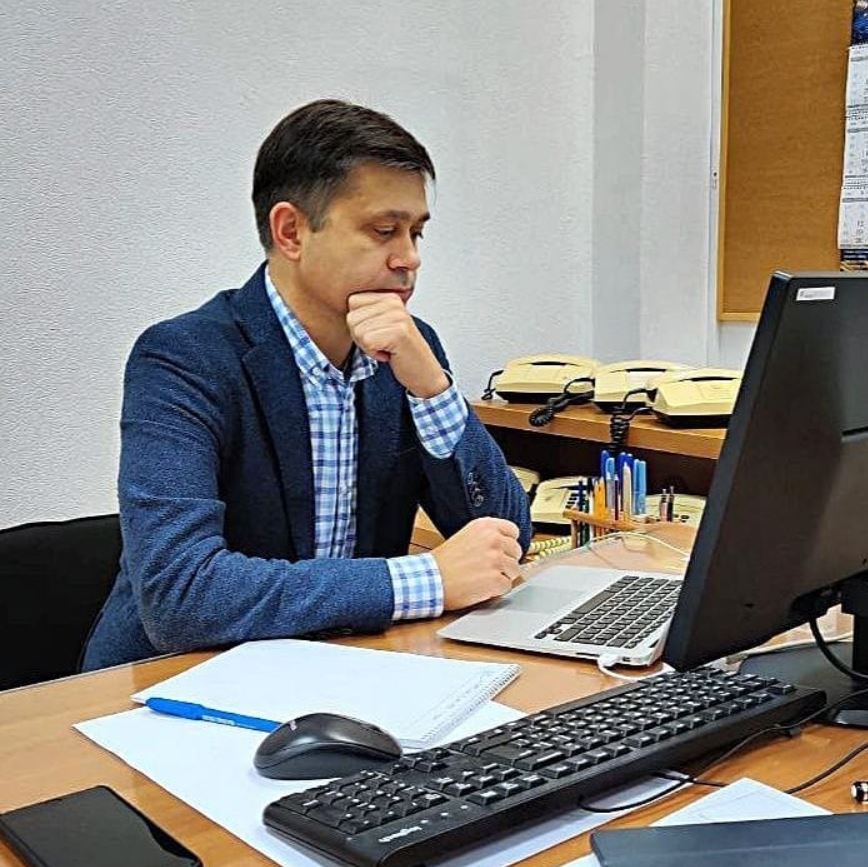

Oleksandr Potiy from the SSSCIP with at least six phones
for dedicated networks, November 13, 2020
(photo: Instagram - click to enlarge)


Videoconferencing systems

Already in 2016, the SSSCIP had developed a new system of secure videoconferencing. When he tested this new system, former president Petro Poroshenko explained:
"In late 2013 and early 2014, the situation was terrible. We had completely Russian software. We had completely open access of the aggressor country to all our state secrets and, in fact, from scratch, we had to develop technical and software tools for protecting information, to provide a radical re-equipment and reboot of confidential communication systems."

Current president Volodymyr Zelensky uses both a commercial Cisco DX80 videoconferencing system and the custom-made secure one, which includes quite bulky equipment, indicating that it is TEMPEST-shielded to prevent electromagnetic emanations:


President Zelensky using the secure videoconferencing system, May 12, 2020.
(photo: Presidential Administration - click to enlarge)


Addressing foreign parliaments

Another kind of videoconferences are the virtual addresses to foreign parliaments which Zelensky started to deliver and included the British House of Commons and the US Congress. In these addresses he dramatically pointed out their responsibility to support the people of Ukraine in their fight against the Russian military agression.

Zelensky usually delivered these speeches from a nondescript room, probably in a bunker. The photo below shows him in a very improvised setting, with the Cisco DX80 videoconferencing screen, an Avaya B149 conference phone, an Apple MacBook, camera equipment and an old-fashioned Soviet-style telephone without rotary dial:
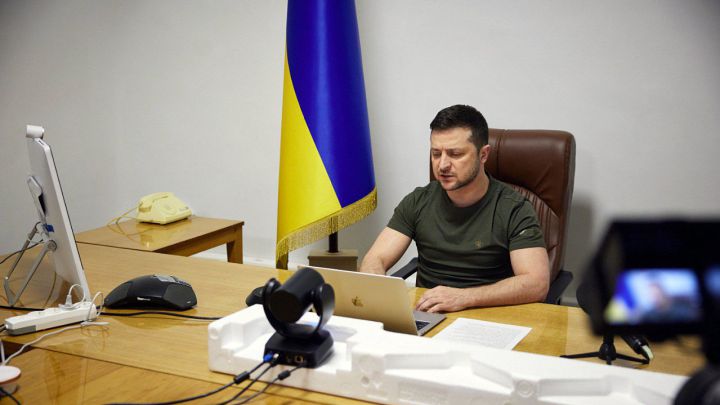

President Zelensky delivering a speech from an unknown location
(photo: DPA vía Europa Press - click to enlarge)


Calls with foreign leaders

In February 2022, when the Russian military threat became imminent, president Zelensky had phone calls with a range of foreign presidents and prime ministers in which he urged them to impose sanctions against Russia and requested arms to defend his country.

For these calls he either used the huge white phone console or a commercial Avaya B149 conference phone, like in the photo below, showing Zelensky when he was talking to Dutch prime minister Mark Rutte on February 23:
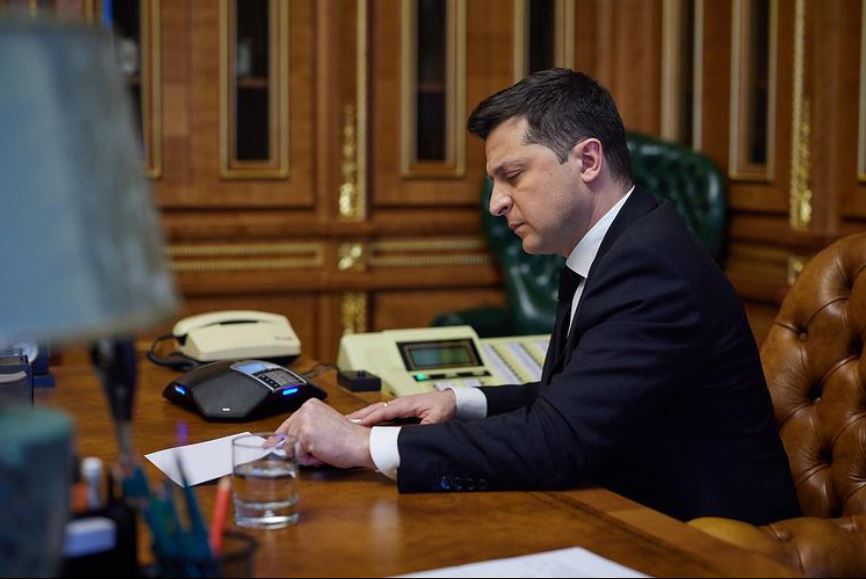

President Zelensky talks to Dutch prime minister Mark Rutte, February 23, 2022
(photo via Instagram - click to enlarge)


Calls with US president Biden

Zelensky also spoke to US president Joe Biden several times, but for these calls a different telephone set was used: a Cisco 7975G Unified IP Phone. This is a common high-end executive phone which was also used for the secure telephone network of the White House until it was replaced by a newer model from Cisco's 8800-series in 2017.


President Zelensky during a phone call with US president Biden, January 27, 2022.
(photo: Ukrainian Presidential Press - click to enlarge)


In the photo we see Zelensky during a long telephone conversation with Biden on January 27, 2022, discussing diplomatic efforts on de-escalation of the Russian threat. A close look at the Cisco phone shows that the wallpaper of the display has an image of the White House, clearly indicating that it's for calls to the president of the United States:


So here we have a rare occasion in which we can see dedicated telephone equipment for a hotline between heads of state. The connection between Zelenksy's office and the White House was probably relayed by the US embassy in Kyiv, like other secure communications between the Ukrainians and US officials, as was reported by CNN.


Secure satellite phones

In February 2022, as fears mounted about the Russian invasion, the US prepared to evacuate its embassy and provided the Ukrainian government with a secure satellite phone to maintain regular contact with president Zelensky, who now moves around to multiple locations in Kyiv that are protected with a significant security presence.

On March 5, Zelensky used this satellite phone for a 35-minute call with his American counterpart on what more the US could do to support Ukraine without entering into direct combat with Russian forces. A similar phone had been provided to Ukrainian foreign minister Dmytro Kuleba.

CNN reported that these satellite phones require electricity but can operate off of a generator or energy from a car if needed. Initially it took a few days for the Ukrainians to get the satellite phones up and working because the instructions on how to use them were in English.
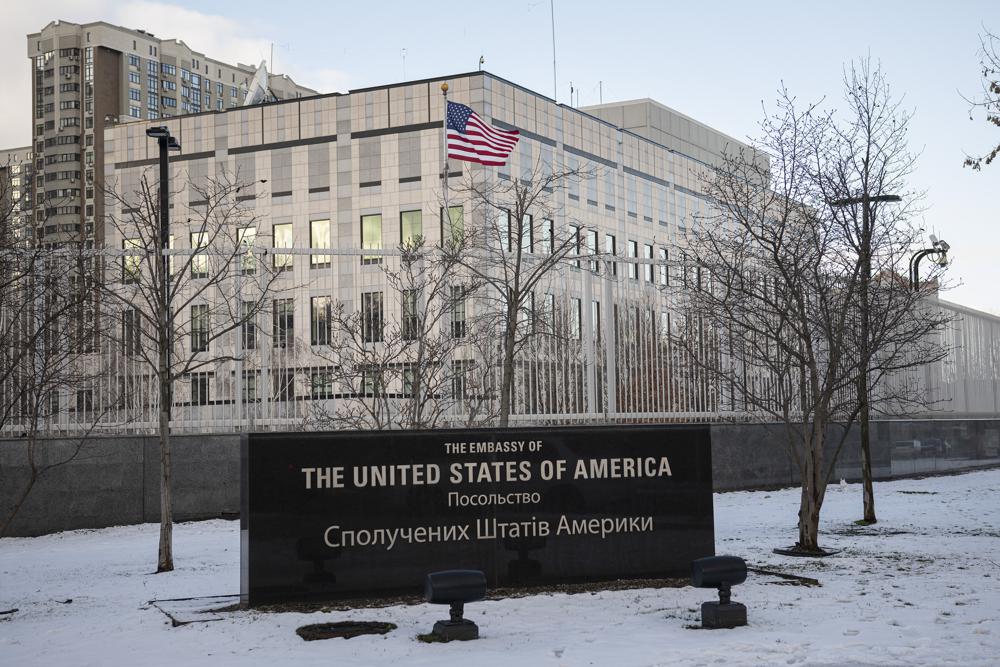

The US embassy in the Ukrainian capital Kyiv.
(photo: Andrew Kravchenko/AP)


Zelensky's smartphone

Finally, Ukrainian president Zelensky also has a smartphone, which he uses to record some of the messages to his people, like the famous one in which he showed that he hasn't left the capital and can still stay in the building of the Presidential Administration on Bankova street (see below).

For a president and other top government officials, a smartphone imposes the risk of being hacked and tracked, but in Zelensky's case we can assume that, besides other security measures, it only connects to a secure base station or a secure wifi router that merely provides access to a sufficiently secured internal network.


Video message by Ukrainian president Zelensky, March 7, 2022.


Links and sources
- CNN: US in contact with Zelensky through secure satellite phone given to him by the US (March 1, 2022)
- The Guardian: The phone has become the Ukrainian president’s most effective weapon (February 28, 2022)
- Telegraf: Страна в смартфоне: как чиновники перейдут со спецсвязи на приложение в телефоне (November 11, 2019)

See also: Comments at Hacker News

January 16, 2020

US government uses Swiss diplomatic network to communicate with Iran

(Updated: November 28, 2020)

A number of countries are connected to each other through bilateral hotlines in order to prevent misunderstandings and miscommunications in times of severe crisis. But what when there's a crisis between two countries that don't have a hotline?

Such a situation occurred after the United States killed the Iranian general Qassem Soleimani on January 3. Because there's no hotline between these countries, the US government used the Swiss diplomatic network urging Tehran not to escalate the crisis, as was reported by the Wall Street Journal.


The Swiss embassy in Tehran
(photo: FDFA - click to enlarge)


Intermediary since 1980

Already since 1980, when Iranian revolutionaries had seized the US embassy in Tehran and took 52 Americans hostage, the Swiss acted as a messenger (or briefträger) between the American and the Iranian government. The US appointed Switzerland as its "protecting power" in Iran and a special United States Interest Section was established in the Swiss embassy for handling informal contacts.

After the American invasion of Iraq in 2003, Swiss diplomats transmitted messages with Iran to prevent direct clashes and under president Obama Switzerland hosted the talks that led to the Iran nuclear deal from 2015. The Swiss ambassador in Iran regularly visits Washington to explain Iran's politics to officials from the Pentagon, the State Department and US intelligence agencies.


The Swiss embassy in Washington DC
(photo: keystone - click to enlarge)


The Soleimani crisis

Details about the informal contacts between the US and Iran have now been revealed by the Wall Street Journal (WSJ): immediately after Washington confirmed the death of general Soleimani on January 3, the US government sent a first urgent message to Tehran asking not to escalate the situation.

The Swiss ambassador delivered the American message by hand to the Iranian foreign minister Javad Zarif early on Friday morning, as the WSJ learned from US and Swiss officials. But Zarif apparently responded to the message with anger, saying that "[U.S. Secretary of State Mike] Pompeo is a bully" and that "The U.S. is the cause of all the problems."

Two days later, on January 5, Zarif called the Swiss ambassador asking to relay his response to the US government, which appeared more restrained. This was followed by a range of back and forth messages, "far more measured than the fiery rhetoric traded publicly by politicians", which for now seem to have helped prevent a military clash between both countries.


The Swiss diplomatic network

The message from the US government to Iran "arrived on a special encrypted fax machine in a sealed room of the Swiss mission" and the WSJ adds that this "equipment operates on a secure Swiss government network linking its Tehran embassy to the Foreign Ministry in Bern and its embassy in Washington. Only the most senior officials have the key cards needed to use the equipment."

Using the secure diplomatic communications network of a third party is a good option for exchanging sensitive messages between two countries, because it's not always possible to set up a direct communications link. One of the difficulties is that in order to encrypt such communications, both parties have to use the same algorithms and, obviously, countries don't like to share their crypto systems with others.

Similar to an official direct bilateral hotline, the back channel through the Swiss diplomatic network appears to be effective, because both parties "can trust a message will remain confidential, be delivered quickly, and will reach only its intended recipients. Statements passed on the back channel are always precisely phrased, diplomatic, and free of emotion" - according to the WSJ report.


The west wing of the Federal Palace (Bundeshaus) in Bern, Switzerland,
home of the Federal Department of Foreign Affairs (FDFA)
(photo: Mike Lehmann/Wikimedia Commons - click to enlarge)


Swiss crypto manufacturers

Switzerland's neutrality is not only useful for diplomatic negotiations, but was also an advantage for the manufacturers of crypto equipment.

One of the oldest companies was Gretag AG, which goes back to 1947. In 1987 most of its cryptographic business was split off and transferred to Omnisec AG, which had been founded especially for this purpose. However, the civil encryption machines as well as those for the Swiss government were sold to AT&T in 1991. Under a new owner, this product line was renamed to Safenet Data Systems, but the company declined rapidly and was liquidated in 2004.

Most of the business had already been taken over by Omnisec AG, which had become one of the most trusted crypto-companies in the world, selling its voice, fax and data encryptors to governments, armies and intelligence services. But gradually the market for proprietary Swiss encryption technology became smaller and smaller and so the company was dissolved in February 2018.

Another Swiss crypto manufacturer is Crypto AG, which was established in 1952 by Boris Hagelin for the activities of his original Swedish company AB Cryptoteknik. Crypto AG became one of the most famous companies in the crypto business, but there were also several allegations that it cooperated with intelligence agencies like the NSA and the German BND.

Update I:

On February 11, 2020, American and German news outlets revealed that in 1970, the CIA and the German foreign intelligence agency BND took over the ownership of Crypto AG, which provided them an easier access to the encrypted diplomatic and military communications of over 100 countries (the Swiss government always got the secure versions of Crypto AG's equipment though). In 1993, the BND sold its share to the CIA, which continued to run the company until 2018, when Crypto AG was sold to a Swedish entrepreneur.

Update II:

In November 2020, the Swiss broadcaster SRF reported that one of the largest competitors of Crypto AG, the Swiss manufacturer Omnisec AG, did the same and sold less secure fax and e-mail encryption devices from their 500-series even to Swiss federal agencies (including the secret services!) as well as to the UBS bank.


The Crypto AG Fax Encryption HC-4221
(photo: Crypto AG brochure)


Swiss fax encryption systems

Both Omnisec AG and Crypto AG produced devices for encrypting fax transmissions. Omnisec had the Omnisec 525 Fax Encryptor, which was available in 2007, while Crypto AG manufactured the Fax Encryption HC-4220, which was succeeded by the HC-4221 and was still available in 2011.

These aren't secure fax machines in the strict sense, but separate crypto devices, which encrypt the signals from a commercial fax machine before being transmitted through the public switched telephone network (PSTN). As can be seen in the photo, the HC-4220 was designed to put the actual fax machine on top of it.

Currently, Crypto AG offers the HC-9300 Crypto Desktop, which is a futuristic looking touchscreen device that performs the encryption of telephone, fax, VoIP and e-mail communications. This device is available at least since 2015 and is approved by the Technical Secretariat of the OPCW to be used for inspections for example.

Maybe the Swiss diplomatic network already uses the HC-9300 to secure its fax messages, but in general, government agencies tend to be rather conservative and stick to older versions, also because new crypto equipment has to undergo rigorous testing before it may be used to protect classified information.


See also:
- The hotline between Washington and the former German capital Bonn
- The Washington-Moscow Hotline


February 14, 2018

The hotlines between North and South Korea

(Updated: July 31, 2021)

The current 2018 Winter Olympics, held in PyeongChang, South Korea, led to a charm offensive by neighbouring North Korea, which included the reopening of a border hotline with the South, that had been closed for almost two years.

The reopening came with new photos of the fancy-looking communications equipment, which will be described here, as well as the fact that there's not just one phone line, but over 40. Unlike other hotlines, the ones between North and South Korea are mostly used for low-level practical issues.


A South Korean liaison officer speaks with his North Korean counterpart over the
inter-Korean communications channel at Panmunjom, January 3, 2018
(photo: Unification Ministry - click to enlarge)


The Red Cross hotline

The first hotline between North and South Korea became operational on September 22, 1971. The link was the result of the first inter-Korean Red Cross meeting held on September 20, which resulted in an agreement to establish two lines for direct telephone calls between the two countries.

It was also agreed to construct a liaison office inside the Joint Security Area (JSA) of Panmunjom, which is in the heavily-fortified Demilitarized Zone (DMZ). The direct telephone link between the liaison offices is therefore often called the Red Cross or border hotline.


Equipment of the hotline

On the South Korean side, the hotline equipment is located in the communication office on the second floor of the Freedom House, which was built in 1998. On the North side, the line ends at a desk in the Panmungak building, which is less than 100 meters (328 feet) away. In the Panmunjom area, the hotlines connect the inter-Liaison Office, the inter-Korean Red Cross Talks Liaison Office and the Front Office of the inter-Korean Talks Headquarters.

The current equipment, which is seen in the most recent photos, was installed in 2009 and consists of a large, wood-panelled console on a desk. On top is a sign that says "South-North Direct Telephone". The system features two disk drives, two sets of USB ports and one computer screen, which shows the Windows XP user interface. It's not clear what the function of the screen is, as there's no keyboard visible.


Equipment of the Red Cross or border hotline on the South Korean side
(photo: YTN News - click to enlarge)


Update: As noted on Twitter, the computer screen appears to show the user interface of a VoIP softphone client, maybe an ancient version of X-Lite, but that hasn't been confirmed yet. Probably this setup made it easier to have the calls recorded, for example by using the CD-stations.


Most important parts are however two telephone handsets, one red and one green. The red one is for incoming calls from North Korea, while the South uses the green handset to make outgoing calls to the North. However, both phone sets are capable of sending and receiving, but there have been installed two of them just in case one fails.

Since 2015, the console has two digital clocks on top, as in that year North Korea shifted to UTC+08:30 or Pyongyang Time (PYT), while South Korea stayed in the UTC+09:00 or Korea Standard Time (KST) zone. In the photo below, the green clock shows 3:34 for South Korea and the orange/red one 3:04 for North-Korea.

At the left of the hotline console there's a Samsung SF 530 fax machine through which North Korea sometimes sends messages about topics that range from logistics to threats.


Operation of the hotline

The hotline phones at the Inter-Korean Red Cross Liaison Office and the Inter-Korean Liaison Office on the South side are operated by officials from the Unification Ministry. They are experts in diplomatic protocol and have in the past played roles in face-to-face talks as well.

To resolve the problem of who calls first, it was decided that the South calls the North on odd dates, while on even dates it's the other way around. The daily routine for weekdays is that communication officials make a phone call everyday at 9:00 AM and again at 4:00 PM. No routine calls are made on Monday morning, Saturdays and Sundays and on bilateral holidays, except for when there are special requests.

The government can instruct to use the hotline for the exchange of official messages, which come in the form of a 'telephone notice' which means that a liaison officer calls the other side and reads a document carrying a proposal or official position on a proposal of the other side. All this is very similar to how the hotline between Washington and Moscow is operated, although that one is just for written communications.

Finally, when a document with official seals has to be delivered to either North or South Korea, a call is made to arrange a face-to-face meeting at a certain time on the demarcation line.


Earlier hotline equipment

The earlier equipment that was used on the hotline of inter-Korean Liaison Office can be seen in a series of photos published on the occasion of its reopening on August 14, 2000, after having been closed since November 1996:


South Korean minister of Unification, Park Jae-kyu using the hotline, August 14, 2000
(photo: The Korea Times - click to enlarge)


The South Korean minister of Unification using the hotline, August 14, 2000
(photo: eHistory - click to enlarge)


This earlier hotline device, with the size of a small refrigerator, has two telephone handsets, one in yellow and one in some kind of light green. In the upper section there's a tape recorder for each of the phone lines. It seems that after the new equipment was installed in 2009, the old device was kept as a remembrance, covered by a blue cloth with a golden fringe:


The old (left) and the new (right) hotline equipment
(photo: Unification News - click to enlarge)


More hotlines between the Koreas

After the Red Cross border hotline at Panmunjom was established, more lines would follow. On April 29, 1972, a direct line between Seoul and Pyongyang was secretly set up to prepare the visit of high-ranking officials to Pyongyang. Following this visit, the director of the CIA contacted North Korean president Kim Il-sung and they agreed upon a direct telephone line for the Inter-Korean Control Committee.

There are no reports about a phone line that connects the presidents of North and South Korea, like for example the famous Washington-Moscow Hotline, or the hotlines between the American president and several other heads of government. (See Update!)


The Joint Security Area (JSA) between North en South Korea, with the
North Korean Panmungak building, seen from the South
(photo: iStock - click to enlarge)


33 hotlines through Panmunjom

More lines were established throughout the 1990s and 2000s and since December 2010 there are 33 direct phone lines which connect North and South Korea through Panmunjom. Five of them are intended for daily communications, 21 for negotiations between the two countries, two for handling air traffic, two for sea transport and three for economic co-operation:

- 2 lines in Panmunjom for the Red Cross, since September 22, 1971.

- 1 line between Seoul and Pyongyang to prepare a high-level visit, since April 29, 1972.

- 20 lines between Seoul and Pyongyang for inter-Korean Red Cross talks, including 2 lines for the Central Red Cross Organisation, since August 18, 1972.

- 1 line between Seoul and Pyongyang for economic talks, since December 20, 1984.

- 2 lines between the newly established inter-Korean Liaison Office in the Panmunjom Freedom House and the Panmokgak building for inter-agency business talks, since May 18, 1992.

- 2 lines between Daegu (since September 18, 2001: Incheon) and Pyongyang for air traffic control, since November 19, 1997.

- 2 lines between Seoul and Pyongyang for the inter-Korean Maritime Authority, since August 12, 2005.

- 3 lines between Seoul and the Kaesong Industrial Complex for the inter-Korean Economic Cooperation Consultation Office, since November 1, 2005.

Several of these direct phone lines through Panmunjom have lost their original function, such as the one for economic talks, but these lines are now for example used as a fax line for communications between the North and South Korean Red Cross Liaison Office, which was opened on April 11, 2004.


The Joint Security Area (JSA) between North en South Korea, with
the new South Korean Freedom House, seen from the North
(photo: jaytindall.asia - click to enlarge)


15 hotlines outside Panmunjom

There are also 15 inter-Korean direct telephone lines which, due to geographical reasons, are not connected to Panmunjom:

- 3 lines between military authorities for the Donghae Bukbu Line, since December 5, 2003 (ultimately terminated in October 2010)

- 6 lines between military authorities for the Gyeongui Line, since August 15, 2005.

- 6 lines between Dorasan Station in the South and Panmun Station in the North for the inter-Korean railroad, since May 14, 2007.


Military hotlines

Besides the aforementioned telephone ines, there are also several military hotlines. In accordance with bilateral agreements, a West Sea communications link was established in September 2002 and an East Sea link in December 2003, each consisting of a phone line, a reserve phone line and a fax line (these lines may well be identical with those for the Gyeongui and the Donghae Bukbu railroads respectively).

Another military hotline was agreed upon in June 2004, in a step towards easing tensions and avoid accidental clashes. On the internet there are at least two photos that apparently show military hotlines between North and South Korea. We see ordinary military field telephones, which don't seem to have encryption capability, but it's possible that they are connected to separate encryption units:


South Korean Lieutenant Choi Don-Rim (left) communicates with a North Korean officer
at a military office near the Demilitarized Zone (DMZ) in 2005.
(photo: AFP - click to enlarge)


A South Korean military official communicates with his North Korean
counterpart through a military hotline, September 6, 2013.
(photo: Yonhap - click to enlarge)


Interruptions of the hotlines

Since the establisment of the first hotline in 1971, the direct communication links between North and South Korea were interrupted seven times, each time by North Korea:

1976:
On August 30, shortly after the Panmunjom ax attack, the hotline was shut down by the North. It was resumed on February 7, 1980 following a first working-level agreement to discuss the inter-Korean prime ministerial talks.

1980:
North Korea unilaterally declared to cease contact on September 24. The hotline was reopened again on September 29, following an agreement with the North Korean Red Cross for consultation on North Korean flood assistance.

1996:
The direct phone lines were aborted immediately after a North Korean submarine ran aground near Gangneung in the South in an attempted infiltration mission. Communications resumed on August 14, 2000 following the first agreement on inter-Korean ministerial talks.

2008:
North Korea declared the hotline "disconnected" after Seoul proposed a resolution about human rights in North Korea during the General Assembly of the United Nations in November. Communications resumed on August 25, 2009 with the visit of President Kim Dae-jung's special envoy to Seoul and inter-Korean Red Cross talks.

2010:
After the Cheonan incident, North Korea shut down all communications channels with the South on May 26. The air control phone line was re-established on October 18, 2010, while the lines at the inter-Korean Red Cross liaison office were reconnected on January 12, 2011.

2013:
On March 11, North Korea had stopped responding to calls on the Red Cross hotlines and also shut down the communication line with the American military command in South Korea, as well as the military telephone and fax lines used to coordinate cross-border travel to the joint industrial park in Kaesong. The North connected the Red Cross hotline again on June 7. A hotline used by military officials regarding travels to Kaesong was restored on September 6, 2013.

2016:
In February, Pyongyang stopped responding to South Korea's calls in the Panmunjom office after Seoul suspended a joint economic project at the Kaesong Industrial Complex over Pyongyang's nuclear tests. The military West Sea hotline was also closed, just like all other hotlines through Panmunjom, except for the two air traffic controle lines.


Reopening in 2018

On January 3, 2018, North Korean leader Kim Jong Un gave the order to reopen the Panmunjom border hotline at 3:00 PM local time. According to South Korea's Unification Ministry, the North Koreans made first contact at exactly the time ordered.

Both sides were on the phone from 3:30 PM to 3:50 PM local time and during this initial 20-minute conversation, the two nations "checked technical issues of the communication line," according to a statement from South Korea's Unification Ministry.

The Ministry said North Korea phoned for a second time several hours later, suggesting the two sides wrap up business for the day. Other than checking that the link was operational, it is unclear what was discussed. According to a ministry spokeswoman there was no mention of future talks or the Olympics.

 
Updates

A top-level telephone hotline between the presidents of North and South Korea was established on April 20, 2018, in preparation of a summit between both leaders later that month in the border town of Panmunjum. Before this meeting, both presidents are expected to have a talk over the phone, but no date has been set for the call.

According to the Yonhap news agency, the new hotline connects the desk of South Korean president Moon Jae-in at the presidential Blue House with North Korea's State Affairs Commission, which is headed by Kim Jong-un. South Korean officials were the first to pick up the phone, then took a return call from their North Korean counterparts to make sure the line was working in both directions.


A South Korean official talks on a phone for testing the new hotline
at the presidential Blue House in Seoul, April 20, 2018
(photo: Yonhap - click to enlarge)


A telephone set that is used for the hotline between
the presidents of North and South Korea
(photo: AFP - click to enlarge)


In June 2020, North Korea cut the hotline as relations soured after a failed summit between the two countries and shortly afterwards, North Korea blew up an inter-Korean border office that had been built to improve communications.

After an exchange of letters between the leaders of North and South Korea, North Korea's news agency KCNA announced that "According to the agreement made between the top leaders, the north and the south took a measure to re-operate all inter-Korean communication liaison lines from 10:00 on July 27." According to South Korea's Ministry of Unification, representatives from both sides spoke on the phone for three minutes. Another call would be conducted on Tuesday afternoon, and henceforth everyday.


Links and sources
- Reuters: Unique 'hotline' sets stage for new North and South Korea talks (2018)
- Korea Exposé: Call Me Maybe: How N. and S. Korea Actually Communicate (2017)
- Huffington Post Korea: 남북 직통전화 개설과 중단의 간략한 역사 (2014)
- Ministry of Unification: 남북관계 지식사전

October 3, 2017

The hotline between Washington and the former German capital Bonn

(Updated: December 1, 2018)

Today, it's the German Unity Day or Tag der Deutschen Einheit, which commemorates the anniversary of the reunification of East and West Germany in 1990.

In recent years, Germany's relationship with the United States had some tough times after it was revealed that chancellor Angela Merkel had been on an NSA targeting list, and a 3-year parliamentary inquiry showed a close cooperation between the NSA and the German foreign intelligence agency BND.

One part of the relationship between Germany and the US that was never reported before, is the existance of a hotline between the White House and the office of the German chancellor. Described for the first time is also the telephone equipment that was used for this kind of top level communications links.


Origins

The hotline (German: heißer Draht) between Washington and Bonn was established on Marz 16, 1962, after German chancellor Konrad Adenauer had met US president John Kennedy in Washington in November 1961. Apparently it was Kennedy who came up with the idea, maybe inspired by the secure telephone line with the British prime minister that already existed since World War II. The famous hotline between Washington and Moscow was established more than a year later, in August 1963.

In October 1966, the newspaper General Anzeiger reported that besides their initial call, Kennedy and Adenauer never used the hotline, and that at the American embassy, no one was aware of this telephone link.

This had led to the strange situation that on September 27, 1966, chancellor Ludwig Erhard and US president Lyndon Johnson, unaware of the hotline established under Kennedy, also agreed to set up a direct telephone line between the White House and Palais Schaumburg, which was the German chancellor's office (Kanzleramt) from 1949 till 1976.

After the press had reported about this agreement, Adenauer said that such a hotline already existed: he had used it for four years and had calls with Kennedy quite frequently. Multiple government spokesmen then claimed that the former chancellor was wrong, until an eye-witness was found who finally confirmed what Adenauer had said.

It's not clear how often Erhard and Johnson used the hotline: one source says they used it several times, another one that it was never used, neither by Johnson and Erhard, nor by Johnson and Kurt Georg Kiesinger, who succeeded Erhard in December 1966.* Under Adenauer and Erhard, the hotline consisted of a normal telephone line without encryption.


Secure teletype

In March 1969, US president Nixon offered chancellor Kiesinger to set up a secure teletype link between the White House and Palais Schaumburg. Were they again unaware of the earlier hotline, or was an encrypted link considered more secure? In those days it was much easier to encrypt teletype messages than a telephone channel.

We don't know whether this secure link was actually established and what equipment was used, but if so, it probably consisted of the same devices used for the hotline between Washington and Moscow: a standard teleprinter made by Teletype Corp. with the encryption being performed by an Electronic Teleprinter Cryptographic Regenerative Repeater Mixer II (ETCRRM II, see photo).

The ETCRRM II used the Vernam stream cipher, in which the plain text message is mixed with a random stream of data of the same length to generate the ciphertext. If used correctly, this method has been proved to be unbreakable.


There are no reports or other sources that mention the hotline between Bonn and Washington after 1969. But a close look at some photos of the chancellor's office show dedicated American telephone sets that enable a direct and secure communications link with the White House.


STU-I telephone

The secure teletype hotline was replaced by a secure telephone link, probably by the end of the 1970s, after the German chancellor had moved his office to the newly built Federal Chancellery in 1976. This modern, dark brown office building with lots of glass is located near the Rhine, right next to Palais Schaumburg.


Office of chancellor Helmut Kohl in the Kanzleramt building in Bonn, 1985
(photo: Archiv Friedrich/Interfoto - click to enlarge)


On the shelf beneath the painting on the right side of the wall we see two telephone sets: at the left a common gray phone without rotary dial, which was probably part of a dedicated telephone network for government (Bonner Behördennetz?) or military communications. On the right there's a standard American telephone set with some additional buttons, which can be recognized as the STU-I secure telephone:


The STU-I was developed by the NSA and introduced in 1977. It was the first secure telephone system that used a central Key Distribution Center (KDC), as well as Linear Predictive Coding (LPC) for better speech quality. Encryption was conducted through the (classified) SAVILLE algorithm, which was developed in the late 1960s by GCHQ in cooperation with NSA for cryptographic devices used by NATO and NATO countries.

It was intended that STU-I would be as compact as possible, but in the end it became a system that consisted of two units: a converted Western Electric telephone set as voice and control terminal, and the actual encryption unit which still had the size of a small refrigerator. Therefore it was often placed in an adjacent room, with a thick gray cable leading to the voice terminal. The price of one STU-I system was 35.000,- US Dollar.


STU-I voice and control terminal
(photo: Cryptomuseum.com)


In the US, the STU-I system was replaced by the STU-II and in 1987, NSA introduced the STU-III. This one-piece secure telephone became very successful and widely used throughout the US government and military. For use by NATO forces and governments of friendly nations there was a modified version designated STU-II/B.

It seems that for the hotline with Bonn though, the old STU-I was kept operational, as its voice terminal can still be recognized in this picture of Helmut Kohl's office in 1991:


Office of chancellor Helmut Kohl in the Kanzleramt building in Bonn, 1991
(photo: picture alliance/Ulrich Baumg - click to enlarge)

Update:

Below is a photo of chancellor Kohl's office in 1989, in which we see that the STU-I telephone had been replaced by its successor, the STU-II. It's not clear how that relates to the previous picture from 1991 in which we see the old STU-I: maybe the dates of the photos are not correct, or the STU-II didn't function well and the STU-I was put back.


Office of chancellor Helmut Kohl in the Kanzleramt building in Bonn, 1989
(photo: imago stock&people - click to enlarge)


IST telephone

Eventually, the hotline between Bonn and Washington did get an upgrade, and the STU-I was replaced by the Integrated Services Telephone (IST). Unlike the STU phones, which are able to encrypt the voice audio themselves, the IST has no encryption capability. Instead, it is connected to a central switch, which separates secure and non-secure traffic, after which the secure traffic is encrypted in bulk by a network encryptor.

On the far right of this photo of the chancellor's office, we can recognize an IST telephone on almost the same spot as where the STU-I phone set was:


Guided tour in the chancellor's office in the Kanzleramt building in Bonn, 1999
(photo: Wikimedia Commons/Ziko-C - click to enlarge)


The phone we see here is about half the size of the standard IST: instead of the 40 direct line buttons, there are just 6, replacing some of the special function buttons above the AUTOVON keypad with the four red keys for the Multilevel Precedence and Preemption (MLPP) function:


The IST was designed by Electrospace Systems Inc. (ESI) and manufactured by Raytheon as a dedicated device for the Defense Red Switch Network (DRSN) - hence it was called a "red phone". The DRSN is the main secure telephone network for military command and control communications and connects all mayor US command centers and many other military facilities.

The small version of the IST is rarely seen, but it was in the collection of the JKL Museum of Telephony in Mountain Ranch, California, which unfortunately was completely destroyed by a wildfire two years ago:


The small version of the IST displayed
in the JKL Museum of Telephony


It is interesting to see that a secure telephone system that was developed for the internal communications of the United States military was also used for links to foreign government leaders. For this purpose the small IST phone was only seen at the German Chancellery, as well as in the office of British prime minister Tony Blair in 2003 - just like there was also an STU-I in the office of Margaret Thatcher in 1987.


Besides the hotline with Washington, there was a direct facsimile communications link between Bonn and Moscow, which was established in 1989.* The Soviet Union also had a hotline with Erich Honecker as leader of the former East-German Republic (DDR) and during a short period before East and West Germany were united in 1991, there was a hotline between Honecker and Helmut Kohl.*


Berlin

On October 3, 1990, East and West Germany were reunited and it was decided to make Berlin the capital again. After being elected chancellor late 1998, Gerhard Schröder moved to Berlin in 1999 and occupied the brand new Chancellery building in May 2001. With over 300 office rooms, this is said to be the largest government headquarters building in the world.

There are several pictures available of the chancellor's office in the Berlin Kanzleramt building, but no one in which equipment for the hotline can be recognized. If this telephone link is still operational, it will be part of the "Head of State network", which is used by the US president to communicate with foreign leaders and was upgraded to an IP-network by the White House Communications Agency (WHCA) in 2009.


Angela Merkel in her office in the new Chancellery building in Berlin, 2016
On her desk there are two regular high-end office phones,
apparently one for secure and one for non-secure calls
(photo: Reuters - click to enlarge)


In October 2013 it was revealed that NSA had tried to eavesdrop on chancellor Merkel's non-secure cell phone. This target was set in 2002, when Merkel was CDU party leader and because then Bundeskanzler Gerhard Schröder refused to join the US in the war against Iraq, the US government was probably interested in knowing the position of his main political opponent.

Although Merkel was an obvious espionage target, the fact that the Americans did so too made her angry: "Spying among friends - that simply isn’t done." She expressed this to president Obama in a phone call on October 23, 2013 and already on July 3, she had talked to him about the Snowden-revelations about Germany. It's not known whether these calls were made using the hotline of the Heads of State network.

This would have been rather ironic, but also typical for the world of espionage and signals intelligence, that on one hand, NSA tried to eavesdrop on chancellor Merkels cell phone, while on the other hand, the US provided highly encrypted equipment for the hotline between both countries.


Links and sources
- Der Westen: Diplomatie am Telefon - Der kurze Draht der Mächtigen
- Telefon Forum: Helmut Kohls Telefone

December 29, 2016

Obama used a cybersecurity link for the first time to warn Russia

(Updated: January 7, 2017)

Shortly before the recent US presidential election, a dedicated cybersecurity hotline with Moscow was used by president Obama to warn the Russian government not to interfere with the election process through hacking operations.

Press reports compared the cybersecurity with the "Red Phone", which many people believe is used on the Hotline between Washington and Moscow. That's not true, and also Obama's message seems not to have been transmitted by phone, but through an e-mail channel which is maintained by the Nuclear Risk Reduction Center (NRRC).


The Nuclear Risk Reduction Center (NRRC) at the US State Department,
which also maintains the cybersecurity communications link
between US and Russian Computer Emergency Readiness Teams
(screenshot from a State Department video)


Obama's message

The fact that on October 31, US president Obama sent the Russians a direct message through the cyber channel was first reported on December 16. Three days later, NBC News came with some details about the content of the message. According to anonymous officials, it included phrases like "International law, including the law for armed conflict, applies to actions in cyberspace" and that the US "will hold Russia to those standards."

However, another senior intelligence official told NBC that the message was "muddled" because there was no bright line laid down and no clear warning given about the consequences. According to the official, the Russian response was non-committal. It's worrying that these government officials are leaking the content of the message, thereby undermining the necessary confidentiality of such an important hotline.

Obama's warning message was not about the hacking of the Democratic National Committee (DNC) or of it's chairman John Podesta, which director of national intelligence James Clapper had previously said was conducted with the knowledge of the Russian leadership. Instead, the warning reportedly only referred to the concerns about hacking around the election process itself.

Updates:

On December 29, 2016, the White House announced actions "in response to the Russian government’s aggressive harassment of U.S. officials and cyber operations aimed at our election." As most visible action, 35 Russian intelligence operatives under diplomatic cover were expelled and two Russian compounds were closed, but although that seemed to be a response to the Russian hacking operations, it was actually a retaliation for the harassment of US diplomats over the past 2 years.
Regarding Russian hacking, only several GRU officials, two Russian hackers and a few Russian companies were named. Also some technical information was published in a Joint Analysis Report (JAR) by the FBI and the US-CERT, to identify Russian cyber attacks, but experts considered this information inconsistent and hardly useful.


US president Obama and Russian president Putin during
the G-8 summit in Northern Ireland in June 2013
(photo: Kevin Lamarque/Reuters - click to enlarge)
 

The cybersecurity link

On June 17, 2013, shortly after the start of the Snowden-revelations, the White House announced that during the G-8 summit in Northern Ireland, Russia and the United States had agreed upon several confidence-building measures (CBMs) to reduce the mutual danger from cyber threats. This includes the regular exchange of technical information about malware and other kinds of risks to critical systems, which appear to originate from each other’s territory and/or could be misperceived as an attack.

Such information is exchanged between the US Computer Emergency Readiness Team (US-CERT), which is part of the National Cybersecurity and Communications Integration Center (NCCIC) of the Department of Homeland Security (DHS), and its Russian counterpart. To provide secure and reliable communication lines for the formal inquiries about cybersecurity incidents, this task was delegated to the Nuclear Risk Reduction Center (NRRC - see below).

Secure voice line

Besides the information channel via the NRRC, the White House and the Kremlin also agreed to set up a direct secure voice communications line between the US Cybersecurity Coordinator at the White House and the Deputy Secretary of the Security Council of Russia, in case there should be a need to directly manage a crisis situation arising from a cybersecurity incident.

The announcement said that this direct voice line "will be seamlessly integrated into the existing Direct Secure Communication System ("hotline") that both governments already maintain" - which indicates that this line runs over the same redundant and secure satellite link as the Direct Communications Link (DCL, which is the official name of the Hotline) and the Direct Voice Link (DVL) between both heads of state.


We have no information about how this direct cybersecurity voice line is secured, but earlier, similar high-level bilateral telephone links consisted of Secure Telephone Equipment (STE), provided by the US.

Usage

As the press reports say that Obama's message was sent via the NRRC, we have to assume that it was in the form of an e-mail, and not a call through the secure voice channel. It was also reported that "the Obama administration had never used the cyber line before", but it's not really clear whether that means that the president never sent a message this way, or that the system was never used in any way.

The latter would mean that since 2013 no information about suspicious network intrusions has been exchanged between Russia en the US. The secure voice line for cybersecurity incidents has then probably also never been used - this kind of high-level direct phone lines seem rarely used in general.


Watch center of the National Cybersecurity and Communications Integration Center (NCCIC),
which includes the US-CERT. On the right there's an STE secure telephone.
(photo: Saul Loeb/AFP/Getty Images - click to enlarge)


The Nuclear Risk Reduction Center

The relay of cybersecurity messages is now one of the tasks of the Nuclear Risk Reduction Center (NRRC), which is located in the US Department of State (DoS). Its Russian equivalent is part of the Russian Ministry of Defence. The Cyber Security Protocol agreed upon in 2013 is the latest of 14 arms control treaties and agreements for which the NRRC exchanges information with more than 55 foreign governments and international organizations.

The NRRC consists of a watch center that operates 24 hours a day, 365 days a year and is staffed by Department of State Foreign Service officers, civil servants, and technical support personnel. They provide and receive inspection notifications, exchanges of data regarding strategic offensive arms, prior notifications of major exercises or unit restructurings, and other treaty-required communications.

The NRRCs were established by an agreement between the United States and the former Soviet Union from September 15, 1987 in order to build confidence through information exchange about their nuclear arsenals. The centers became operational on April 1, 1988. After the split-up of the Soviet Union in 1991 this secure data link, officially called Government-to-Government Communication Link (GGCL), was extended to Ukraine, Belarus and Kazakhstan.

Initially, these communication links consisted of facsimile devices, with (one-time pad) encryption conducted by personal computers and the random keys provided on 5¼ inch floppy disks, just like on the Washington-Moscow Hotline. As of late 1995, the NRRC communications shifted to encrypted e-mail with an additional chat channel for coordination purposes.


State Department video about the Nuclear Risk Reduction Center (2012)
(click to play)


Red Phone versus Hotline

It may be more than clear now that Obama's warning message had nothing to do with a "Red Phone", but it should be mentioned that the White House and the military did use red phones, although not for international, but for internal communications between the president and the military command centers. This was achieved through a secure military telephone network: the Defense Red Switch Network (DRSN).


Through popular culture, the image of a red telephone became projected to the direct communications link between Washington and Moscow, but this is false: the Hotline was never a phone line, as it was set up in 1963 as a teletype connection, which in 1988 was replaced by facsimile units. Since 2008 the Hotline is a highly secure computer link over which messages are exchanged by e-mail.


What the Hotline terminal at the Pentagon looks like nowadays can be seen in the following picture, which was released on the occasion of the 50th anniversary of this communications link in 2013:


The Washington-Moscow Hotline terminal room at the Pentagon (2013)
(photo: www.army.mil - click to enlarge)
 

Other options?

Besides the cybersecurity channels, the NRRC and the Hotline, the US government has two additional channels for direct communications with the Kremlin: the Foreign Affairs Link (FAL) between the State Department and the Russian foreign ministry, and the Defense Telephone Link (DTL) between de defense ministries of both countries. Both are secure phone lines, which also exist with a range of other countries.


This means that president Obama had several other options for transmitting his warning to Russia. It seems the NRRC cybersecurity channel was chosen because it was about the threat of cyber attacks, but still, such a warning message seems not what that channel is meant for, which is the exchange of technical information about actual intrusions that could be misinterpreted as a deliberate attack.

Therefore, the Foreign Affairs Link (FAL) would probably have been more appropriate: US secretary of state John Kerry could have called his Russian counterpart to issue the warning. But generally, for important messages in which every word counts, written communications are preferred, so that left only the NRRC or the Hotline.

Using the Hotline was probably considered too dramatic, and therefore the remaining option was the cybersecurity channel maintained by the NRRC.


Links and sources

- The Washington Post: Obama’s secret struggle to punish Russia for Putin’s election assault (2017)
- New York Times: Obama Administration Rushed to Preserve Intelligence of Russian Election Hacking (2017)
- NextGov: Obama's cyber legacy: He did (almost) everything right and it still turned out wrong (2017)
- The Washington Post: Obama administration is close to announcing measures to punish Russia for election interference (2016)
- EmptyWheel: Now the spooks are laking criticism of Obama's sole use of the "Red Phone" (2016)
- NBC News: What Obama Said to Putin on the Red Phone About the Election Hack (2016)
- The New York Times: White House Confirms Pre-Election Warning to Russia Over Hacking
- The White House: U.S.-Russian Cooperation on Information and Communications Technology Security (2013)

Some older articles on this weblog that are of current interest:
In Dutch: Volg de actuele ontwikkelingen rond de Wet op de inlichtingen- en veiligheidsdiensten via het Dossier herziening Wiv 2017