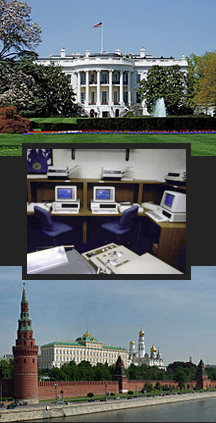
Among the most special telecommunication links are those between the presidents of the United States and Russia. The first and most famous one is the Hotline from 1963, but contrary to popular belief it never had red telephone sets, because it started as a teletype link that evolved into a secure e-mail system.
Only in 1990, a separate secure telephone line was established between the Kremlin and the White House, which was integrated into a digital computer network in 2008. This also enables video calls, a capability that was first used by US president Biden and Russian president Putin only two weeks ago, on December 7, 2021.
US president Biden talking to Russian president Putin from
the White House Situation Room, December 7, 2021.
(photo: White House - click to enlarge)
The Biden-Putin video call
The Russian news agency TASS reported that "the video conference was organized via a secure video conference line, designed for communication between world leaders, and used for the first time today" - a memorable moment, but hardly any other news outlet mentioned it.
Maybe that's because the American and the Russian president had already participated in several multilateral video conferences, like for example the G20 summit in Riyadh in November 2020, and therefore this first bilateral video call seemed not that special anymore.
US president Joe Biden attended the virtual meeting from the large conference room in the White House Situation Room, which is in the basement of the West Wing of the White House. Also present were national security adviser Jake Sullivan, secretary of State Antony Blinken and Eric Green, a senior advisor on Russia.
Russian president Putin talking to US president Biden at
his Bocharov Ruchei residence, December 7, 2021.
(photo: Kremlin via EPA - click to enlarge)
Russian president Vladimir Putin conducted the video call from a conference room in Bocharov Ruchei, which is the summer residence of the Russian president in the Black Sea resort of Sochi. In the photos and video released by the Kremlin no aides or other officials were visible.
An interesting little detail is that the security camera in the corner of the room seems to be covered in black plastic, likely to prevent the ordinary security personnel from watching and/or listening to the video call with president Biden:
Another detail is that president Putin seems to have a white button in front of him, probably similar to the call button in the White House which the American president can use to summon assistance. Under Trump this became known as the "Diet Coke Button".
Close-up of the white button in front of president Putin,
next to an ivory Prestige-CB phone made by Telta
(photo: Mikhail Metzel, Sputnik, Kremlin Pool Photo via AP)
Start and duration of the video call
A brief snippet broadcast by Russia state television shows that the two leaders offered friendly greetings to each other: "I welcome you, Mr. President," Putin said, but US president Biden seemed to fumble with his microphone, awkwardly waving to his Russian counterpart during the silence.
After a few seconds, Biden leaned forward and pressed a button on the control panel of the video teleconference (VTC) system. This apparently turned his microphone on: "There you go" he said, suddenly audible, chuckling and waving to Putin.
The AMX control panel of the videoconferencing system in the White House Situation Room
After president Biden expressed his hope for an in-person meeting with the Russian leader in the future, further talks proceeded in private. Biden and Putin spoke to each other for just over two hours, according to the White House from 10:07 a.m. to 12:08 p.m. Eastern Time, or 18:08 to 20:10 Moscow Time.
Putin's foreign affairs adviser Yuri Ushakov described the presidents' video conference as "candid and businesslike," adding that they also exchanged occasional jokes. Biden's national security adviser said the meeting was "useful", the discussion "direct and straightforward" and "There was no finger wagging."
After the video call with Putin, president Biden had a telephone (conference?) call with France's president Emmanuel Macron, German chancellor Angela Merkel, the British prime minister Boris Johnson and Italian prime minister Mario Draghi to brief them about the conversation with the Russian president.
Updates:
On December 30, 2021, US president Biden and Russian president Putin had their second conversation within a month. This time it was a 50-minute telephone call, which was requested by Putin and was about the ongoing crisis around Ukraine.
President Biden speaks on the phone to president Putin
from his home near Wilmington, Delaware on December 30, 2021
(photo: AFP/Getty Images - click to enlarge)
On February 12, 2022, Biden and Putin had a phone call of just over an hour again about a possible Russian invasion of Ukraine. This time, the American president conducted the call from the conference room in Camp David, the presidential country retreat near Thurmont in Maryland:
President Biden having a call with president Putin, February 12, 2022
(photo: White House/Reuters - click to enlarge)
US-Russian communication links
It should be noted that neither the video call, nor the telephone conversations between the presidents of Russia and the United States are conducted through the famous Hotline between Washington and Moscow. This Hotline, which is officially called the Direct Communications Link (DCL), was established to prevent nuclear war and is formally based upon a memorandum between the United States and the Soviet Union from June 20, 1963.
In popular culture the Washington-Moscow Hotline is often called the Red Phone, and therefore many people think it has red telephone sets, but this is false: the Hotline was never a phone line. It was set up as a teletype connection, which in 1988 was upgraded to inlcude facsimile (fax) units. Since 2008 the Hotline is a highly secure computer link over which messages are exchanged by e-mail.
The Washington-Moscow Hotline terminal room at the Pentagon in 2013
(photo: www.army.mil - click to enlarge)
The American president did use a red telephone though, although not for foreign, but for domestic communications. Quick and easy contact between the president and military commanders is of course just as important as contact with the Kremlin, and this was achieved through a secure military telephone network, called the Defense Red Switch Network (DRSN).
While president Reagan used to write letters to his Soviet counterparts, his successor George H.W. Bush had his first phone call with general secretary Mikhail Gorbachev already on January 23, 1989, three days after his inauguration. This established the practice of direct calls to the Soviet leadership, which were to prove very productive.*
Therefore, the United States and the Soviet Union signed an agreement on June 2, 1990 to set up a "Direct, Secure Telephone Link between Washington and Moscow". This agreement was updated by the memorandum of understanding between the United States and the Russian Federation from October 15, 1999.
The official name of this telepone line is Direct Voice Link (DVL) and it connects the White House with the office of the Russian president, initially via the same satellite link as the Hotline. But while the Hotline is designated for top level crisis communications, the Direct Voice Link can be used for routine matters and the calls are usually scheduled in advance, so interpreters can be present.*
President Obama using his telephone for secure calls in the Oval
Office to talk to Russian president Putin, March 1, 2014.
(White House photo by Pete Souza - click to enlarge)
A Russian integration proposal
From the declassified Presidential Review Directive/NSC 51 by president Clinton's national security advisor Anthony Lake from February 28, 1995, we learn that:
"The Russian government has recently tabled a proposal to upgrade existing government-to-government communications links between Washington and Moscow by installing a secure digital network with voice, data and teleconferencing capabilities. Significantly, the Russian proposal would integrate the existing Direct Communications Link, the secure Direct Voice Link, and the Nuclear Risk Reduction Center communications network in a manner that would permit intergovernmental communications between the U.S. and Russian presidents as well as other government officials; it would also provide the capability to convene conference communications involving Washington, Moscow and "third parties," e.g., other capitals of the Newly Independent States."
In reaction to this proposal, the senior director for Defense Policy of the US National Security Council set up an interagency working group, to "reexamine the purpose, function and overall architecture of direct communications networks between Washington and Moscow."
I haven't found the conclusions of this working group, but given the fact that the different communication systems continued to exist, indicates that at the time the US did not agree to the Russian proposal.
Eventually, the Russians partly got what they wanted, because on October 30, 2008, an agreement was signed on the establishment of a "direct secure communications system between the United States of America and the Russian Federation".
This agreement supersedes and terminates the earlier agreements and memoranda of understanding about both the Hotline (from 1963, 1971, 1984 and 1988) and the Direct Voice Link (from 1990 and 1999).
The new system consists of "networked equipment and communications circuits and [is] intended for secure emergency and non-emergency communications
between the highest leadership of the two countries." To make the system suitably reliable, the "communications circuits shall follow geographically diverse paths" and both countries agreed to equally share the cost of leasing communication circuits that run outside their territory.
According to the agreement it was up to the Defense Information Systems Agency (DISA) on the American side and the Federal Protective Service (FSO) on the Russian side to "determine the configuration and technical parameters of the communications circuits, as well as the specific types of encryption devices and equipment to be used."
It was also agreed that "the secure communications system shall be reequipped and updated every five years" while it may also be used to transfer classified information, but only up to the level Secret, as the agreement only mentions the classification markings Secret (Russian: Совершенно секретно) and Confidential (Секретно).
Since the new system became operational, probably in the course of 2009, there's one secure network between Washington and Moscow which is used for the e-mail capability of the old Hotline as well as for the direct telephone line between both presidents.
Since 2013 the network is also used for "a direct secure voice communications line between the U.S. Cybersecurity Coordinator and the Russian Deputy Secretary of the Security Council, should there be a need to directly manage a crisis situation arising from an ICT security incident."
And likewise the video call between Biden and Putin must also have been conducted through the Direct Secure Communications System, although it's not clear why it took so long before this capability was first used.
The Head-of-State Network
The new secure communications network between Washington and Moscow has probably been integrated in the Head-of-State (HoS) network which the president of the United States uses to communicate with foreign leaders.
According to the 2009 budget of the White House Communications Agency (WHCA), which is part of DISA, this Head-of-State network was upgraded to an IP network and expanded with "new suites and additional network capacity", a project that was finally completed in the fiscal year 2013.
There's very little information about the Head-of-State network, but we can assume that it includes at least the countries that previously had a bilateral top-level hotline with the White House: Russia, the United Kingdom, Germany, India and probably China. Other allied countries are likely also included.
A small room within the White House Situation Room where the president
"can make a head-of-state phonecall from the Situation Room itself"
(screenshot from a White House video)
Head-of-State phone calls
Presidential phone calls to other heads of state are usually prepared by the senior duty officer (SDO) of the White House Situation Room who negotiates date and time with the designated contact in the foreign capital and arranges an interpreter from the Language Service of the State Department.* Subject-matter experts from the National Security Council (NSC) may also listen in to the call.
These phone calls are not recorded, but duty officers in the Situation Room take verbatim notes which are put together in a Memorandum of Conversation (MemCon). An example is this one of the famous last phone call between presidents George H.W. Bush and Mikhail Gorbachev on December 25, 1991. Nowadays these MemCons are stored on TNet, the internal computer network for the NSC staff.
When the Situation Room has no dedicated link to a particular foreign leader, then the call would be set up through the so-called Signal switchboard, which is staffed by military personnel from the White House Communications Agency.*
The Signal switchboard is also used for all other secure phone calls and thus we see that the IST2-telephone used by presidents George W. Bush and Barack Obama had separate buttons not only for the Situation Room, but also for the Head-of-State conference calls, the Signal switchboard and its operator for secure calls:
Securing the networks
For obvious reasons there's no information about how the Head-of-State network and the Secure Communications System between the US and Russia are secured. For its own classified IP networks, the US military uses advanced network encryptors, like the TACLANE series made by General Dynamics. These devices are certified by the NSA as Type 1 product that use classified Suite A algorithms to encrypt communications data up to the highest classification level (Top Secret/SCI).
For such an encryption system, however, both parties have to use the same equipment, or at least the same algorithms and that's a problem when it comes to bilateral communications: one country will of course never provide it's best encryption systems to another country. One solution is to use less secret methods, like the Advanced Encryption Standard (AES), which is considered one of the best publicly available encryption algorithms.
Responsible not only for securing the Direct Voice Link (DVL), but also for Obama's BlackBerry, was Richard "Dickie" George, who served as technical director of the NSA's Information Assurance Directorate (IAD) from 2003 until his retirement in 2011.
When head-of-state communications should be as secure as possible, then they could use a one-time pad (OTP), which is unbreakable if implemented correctly. Instead of an algorithm, the OTP method uses a completely random key that is as long as the message that has to be encrypted.
In this way both the original Hotline and the communication links of the Nuclear Risk Reduction Center (NRRC) were secured: "The information security devices shall consist of microprocessors that will combine the digital message output with buffered random data read from standard 5 1/4 inch floppy disks" which each party provided to the other through its embassy.
Russian equipment?
In August 2018, several Russian state media came with a somewhat confusing story saying that "a sophisticated scrambler developed by Concern Avtomatika was tested by US specialists and recommended for use in the direct telephone link connecting Washington with Moscow."
Avtomatika and its predecessors have been manufacturing cryptographic equipment for secure top-level telecommunications already since 1930. In 2014 Avtomatika became part of the state-owned defense conglomerate Rostec.
In October 1962, the Cuban Missile Crisis ended and the world was saved from falling into a nuclear war. In order to prevent this risk in the future, the United States and the Sovjet Union established a direct communication line between their two capitals in August 1963. This Washington-Moscow Hotline became one of the most famous top level communications systems in modern history.
In popular culture, the Washington-Moscow Hotline is often called the Red Phone, and therefore many people think it's a telephone line, with a red phone set on the president's desk. However, this is false: the Hotline was never a phone line, but instead set up as a teletype connection, which in 1988 was replaced by facsimile units. Since 2008 the Hotline is a highly secure computer link over which messages are exchanged by e-mail.
Given the growing threat of a nuclear war, leaders in Washington and Moscow realized already in 1954 that a direct line of communications between their two nations was needed to prevent such a disaster. The Soviets floated the idea publicly for the first time that year, and in 1958 the United States proposed that both nations take part in the Conference of Experts on Surprise Attack in Geneva, Switzerland.
Also in 1958 the political economist and nuclear strategist prof. Thomas Schelling proposed the idea of a hotline between both super powers. A direct phone line also featured in the novel Red Alert by Peter Bryant from the same year. Based upon this novel was Stanley Kubrick's 1964 film Dr. Strangelove, both showing how a nuclear war breaks out because of bad communications.
What shaped people's imagination:
the American president (right), assisted by the Russian ambassador, calling his Soviet counterpart in the 1964 film Dr. Strangelove
In 1960, Jess Gorkin, editor of the magazine Parade, published an open letter in his magazine to President Dwight D. Eisenhower and the Soviet leader Nikita Khrushchev, concluding with: Must a world be lost for want of a telephone call? However, the military and diplomats of the State Department didn't like the idea of the president talking behind their backs with the Russians and reportedly objected the proposal of a direct line.
During the Cuban Missile Crisis in October 1962 it clearly came out that the existing ways of communicating between Washington and Moscow were too slow for the events happening. It took Washington nearly 12 hours to receive and decode Khrushchev's 3,000 word initial settlement message.
By the time a reply had been written and edited by the White House, Moscow had sent another, tougher message. Under severe time pressure, both leaders ultimately decided to communicate through the media. After the crisis was resolved, the hot line proposal became an immediate priority.
After some negotiations, the United States and the Sovjet Union signed an agreement about establising a Direct Communications Link on June 20, 1963 in Geneva. The official American name for the Hotline is Direct Communications Link (DCL), but US technicians often call it MOLINK, being a military style abbreviation for "Moscow-link".
Installation
On July 13, 1963, only a month after signing the agreement, the United States sent four sets of teleprinters with Latin alphabet to Moscow for their terminal. This was done via US ambassador Averell Harriman's plane. Another month later, on August 20, the Soviet equipment, four sets of teleprinters with Cyrillic alphabet, arrived in Washington. The cipher machines for encrypting the Hot Line messages came from Norway. According to the agreement, all these machines should be accompanied by a one years supply of spare parts and all the necessary special tools, test equipment, operating instructions and other technical literature.
Russian technicians preparing the equipment for the new Hotline in the Central Telegraph Bureau in Moscow.
In the foreground we see the East German T-63 cyrillic teleprinter.
(photo: TASS via AP, July 17, 1963)
News report of the Russian teleprinters being installed at the Pentagon
Two unique color film fragments of the Russian teleprinters arriving and being installed at the Pentagon can be seen here: Part 1 - Part 2
The new Hotline became operational on August 30, 1963, by transmitting the first test messages. Washington sent Moscow the text The quick brown fox jumped over the lazy dog's back 1234567890, which is a so called pangram of all letters and numbers of the Latin alphabet. The Soviets sent back a poetic description of Moscow's setting sun.
When the Hotline was established in 1963, it was a full-duplex teletype channel, which was routed trough telephone cables from Washington, over the undersea Transatlantic Cable No. 1, to London, and from there to Copenhagen, over Stockholm and Helsinki to Moscow. In London, the Washington-Moscow Hotline cables were connected by a secure telephone exchange, situated in a huge underground tunnel complex, The Kingsway Tunnels, built during World War II.
This cable connection was for the political communications, but appeared not fully fail safe: the cable was accidently cut several times, for example near Copenhagen by a Danish bulldozer operator and by a Finnish farmer who plowed it up once.
Besides this wire line link, there was a full duplex teletype radio circuit, routed from Washington via Tangier (Morocco) to Moscow. This was for service communications and served as a back-up.
The Hotline terminals
In Moscow, the terminal of the Hotline was supposed to be in the Kremlin, somewhere next to the office of the prime minister. However, Soviet leader Leonid Brezhnev once told a group of Moscow-based American journalists, that their terminal was on the opposite side of Red Square, in the Communist Party headquarters. The Russian terminal was manned by civilians, the American one by the military.
An East German T-63 teleprinter, used at the Moscow terminal of the Hotline
(photo from an exhibition at the Russian Archives)
On the American side, there are Hotline terminals at these four locations:
- The National Military Command Center (NMCC) in the Pentagon
- The Alternate National Military Command Center (ANMCC) in the Raven Rock Mountain
- The military communications center in the White House
- An unknown location in the State Department
Pentagon Terminal
The primary US terminal is at the National Military Command Center (NMCC) in the basement of the Pentagon. There, the Direct Communications Link is a joint staff operation under the control of the Joint Chiefs of Staff J-3 Operations Directorate. The NMCC is responsible for routine testing of the Hotline and for the receipt, transmission and translation of the messages by highly qualified translators.
The terminal is manned by six teams of two man each, working in 8-hour shifts and led by a commissioned officer acting as Presidential Translator (PT). For the routine shift operations, the Hotline personnel falls under the command of the flag officer in charge of the NMCC. But when a real message from Moscow arrives, the doors of the terminal room are closed and locked and the personnel becomes subject directly to the president himself.
The rack with the Primary Tech Control (PTC) equipment at the NMCC
(photo: private collection - click to enlarge)
White House Terminal
When in June 1967 the Soviets sent their first message, secretary of defense Robert McNamara found out that the Hotline ended in the NMCC, instead of at the White House, as he had expected. McNamara ordered a quick patch from the Pentagon to the White House, which was later formalized by installing an ancillary terminal in the military communications center of the White House Communications Agency (WHCA) in the East Wing basement. From there, incoming messages from the Hot Line were sent to the Situation Room under the West Wing, first by pneumatic tube and later, after computers were installed in both rooms, by data transmission.
The White House terminal also has the capability to send and receive messages and has additional privacy and override features which will allow it to "lock out" other Hotline terminals. The White House terminal is manned and operated by White House personnel of the WHCA. In 1988, the White House communications center was connected to the Pentagon MOLINK office with a facsimile link, two secure telephone lines and an open, non-secure telephone line.*
The rack with the T2 equipment at the White House
(photo: private collection - click to enlarge)
Other US Terminals
Another Hotline terminal is located at the Alternate National Military Command Center (ANMCC), which is situated in the Raven Rock Mountain and serves as a back up facility for the Pentagon. This terminal has the capability to serve as an alternate center for originating and receiving messages. The ANMCC terminal is manned and operated by NMCC personnel, which is also responsible for the periodic testing of this terminal.
According to a 2013 report, the Hotline also has a link to the State Department.
In a paragraph classified as Secret of the 1985 presidential directive about the operation of the Hot Line, which in the meanwhile has been declassified, it was said that at the sole discretion of the president, additional locations for access to the Hotline may be established. The existence of these sites should be classified as Secret.
The rack with the Alternate Tech Control (ATC) equipment at the ANMCC
(photo: private collection - click to enlarge)
Record communications
Contrary to the myth of a phone line, the Washington-Moscow Hotline has always been for record communications. The idea behind this is that a telephone link could increase the possibility of misunderstanding rather than eradicate it. In times of crisis, mistakes come at a high price. Exchanging written messages gives both parties time for reflection and responding after deliberation. The telephone does not allow this latitude, but on the contrary compels a response of some sort, which can result in a misguided reply or a misunderstood answer.
Another reason for the Hotline not being for phone conversations was of technical nature: in the sixties it was hardly possible to realize voice encryption strong enough for top level communications. From the mid-seventies some better techniques were developed, but these were secret national algorithms, which of course couldn't be shared with the Soviets. Unclassified commercially available voice encryption was hardly secure.
The interior of an East German T-63 SU12 teletype printer
as photographed in the National Cryptologic Museum of the NSA.
At the left we see a green box containing the key tape.
(Photo: Wikipedia - click for a bigger version)
1963: Teletype equipment
The original teletype equipment of the Washington-Moscow Hotline consisted of the following machines:
- Teleprinters with Latin alphabet: Model 28 ASR, made by the Teletype Corp.
- Teleprinters with Cyrillic alphabet: T-63 SU12, made by VEB Messgerätewerk Zwönitz in East Germany, based on the earlier Siemens T-37 teleprinter.
For the encryption of the messages, each of these teleprinters was connected to an ETCRRM II machine, which will be discussed later on. We can clearly see the equipment in this picture of the Hotline terminal room at the Pentagon:
The Washington-Moscow Hotline terminal room in the NMCC at the Pentagon, 1966.
At the left side, there's the Teletype Corp. Model 28 ASR teleprinter in the foreground,
two black ETCRRM II encryption machines in the middle, and top left a T-63 SU12 teleprinter.
This arrangement is mirrored at the right side of the room.
(Photo: June 1966)
As we can see by comparing the previous picture with the next one, the Hotline equipment in the Pentagon was rearranged, and maybe also replaced to another room, after 1966. Maybe this happened in 1967, when defense secretary McNamara ordered that the Hotline should be extended to the White House.
The Hotline terminal room in the NMCC at the Pentagon, 1976
With two Latin alphabet and two cyrillic alphabet teletype machines (light coloured) and four ETCRRM II cipher machines (black).
(Photo: UPI, July 9, 1976)
In 1980, the equipment was replaced by newer teletype printers and Siemens M-190 encryption machines, as can be seen in the picture of the Hotline room from 1985:
The Hotline terminal room in the NMCC at the Pentagon, 1985
With the new teletype and encryption equipment, installed in 1980.
In the foreground we see a Siemens M-190 cipher machine.
(Photo: AP, August 27, 1985)
Shortly after the previous picture was taken, facsimile units and personal computers with printers were added to the Washington-Moscow Hotline. For a couple of years they were tested and used alongside the existing teletype equipment, as can be seen in the picture:
The Washington-Moscow Hotline terminal room in the NMCC at the Pentagon, 1985
We see four personal computer terminals with printers for the coordination channel
Just like the teleprinters, two of the computers had a Cyrillic keybord and two a Latin keybord
In the foreground we still see a teleprinter and a Siemens M-190 cipher machine
(Photo: Time-Life/Scott Davis, November 14, 1985)
Teletype encryption
From the beginning, the confidentiality of the messages through the Washington-Moscow Hotline was assured by encrypting them using the one-time tape method, which has been proved unbreakable if used correctly.
The encryption of the teletype transmissions was realised by an Electronic Teleprinter Cryptographic Regenerative Repeater Mixer II, short ETCRRM II. As one of many one-time tape machines sold by commercial firms in those days, this one was produced by the Standard Telefon og Kabelfabrik (STK) in Oslo, a Norwegian subsidiary of the American telecommunications company ITT. It was also commercially available for about 1000,- USD, so for securing the Hotline, neither party had to disclose any of their own secret cryptographic methods.
The ETCRRM II used the Vernam stream cipher method, in which plain text message is eXclusively OR'ed (XOR'ed) with a random stream of data of the same length to generate the ciphertext. Once a message was enciphered the keytapes were destroyed. At the receive end, the process was reversed to decode the meassage, for which an identical keystream tape was needed.
In 1980 the ETCRRM II was replaced by the German Siemens M-190 cipher machine, which also uses the Vernam principle for one-time tape encryption. This device stayed in use until the teletype connection was terminated in 1988.
According to the agreements, each country prepared the keying tapes used to encode its messages and delivered them, through a courier, at their embassy in the other country, from where they were brought to the counterpart's terminal. So, the keys used for encrypting the messages sent from Washington, were brought to the American embassy in Moscow, who delivered them to the Russian hotline terminal.
In the US, the key tapes were provided by the Office of Communications Security (now: Information Assurance Directorate) of the NSA. Just imagine the logistics needed for providing not only the Pentagon and the White House terminals, but also the American embassy in Moscow with these key tapes every single day!
A Siemens M-190 encryption machine
(photo: CryptoMuseum.com)
1978: Satellite link
On September 30, 1971, the United States and the Soviet Union signed an agreement in Washington to modernize the Hotline. The primary cable link was replaced by two satellite circuits: the United States was to provide one circuit via the commercial Intelsat IV system, with satellites in a geosynchronous orbit. The Soviet Union would provide another circuit via four satellites of their Molniya II system on a highly elliptical orbit.
This modernization program started in 1971 and, after four years of testing, the satellite link finally became operational on January 16, 1978. This link provided more flexible communications and made the Hot Line less vulnerable than the original landline. The teletype circuit over the undersea and land line cable was retained as a backup to the satellite links, but the teletype radio circuit from Washington over Tangier to Moscow was terminated.
Maybe it's because the 1971 agreement says: "The two circuits shall be duplex telephone band-width circuits (...), equipped for secondary telegraphic multiplexing", that some sources erroneously say that in the seventies a telephone capability was added to the Hot Line.
Sign at the US hotline satellite earth station at Fort Detrick (photo by Tim Tyler)
Earth stations
Both in the United States and in the Soviet Union satellite earth stations were equipped for the Hotline transmissions. For the signal of the Russian Molniya satellite, a new earth station was built at Fort Detrick, Maryland. For the Intelsat link, the US used the commercial Intelsat ground station at Etam, West Virginia. Commercial circuits connect these earth stations to the Hotline terminal at the National Military Command Center in the Pentagon.
The Soviets originally intended to use an earth station in the suburbs of Moscow for the Intelsat link and a Molniya station at Vladimir. However, because of severe winter weather conditions in the Soviet Union, the Russians constructed a second Intelsat earth station, approximately 50 miles from L'vov, to ensure increased dependability.* Since 1991 L'vov is in Ukraine, so it's likely the Russians moved their Intelsat earth station to another location.
The rack with the Earth Station 2 (ES2) equipment at
the Intelsat ground station in West Virginia
(photo: private collection - click to enlarge)
Detrick Earth Station
The US ground station at Fort Detrick was built by the Radiation Division of the Harris Corporation, and became operational in the Spring of 1974. Harris operated and maintained the station and its equipment through 1977. Since 1981 Honeywell Technology Solutions Inc (HTSI) provides 24/7 Russian linguist support and technical support for the operation of the Detrick Earth Station (DES), ensuring that the availability is maintained at greater than 99.97 percent. A renewed five-year $8.4 million contract with Honeywell ends in February.
The US earth station at Fort Detrick, Maryland
with the 1974 dishes for the Russian satellites.
(photo: www.bfec.us)
The rack with the Earth Station 1 (ES1) equipment at Fort Detrick
(photo: private collection - click to enlarge)
The Detrick earth station was modernized by the Satellite Communications Systems of the US Army in 2007. Outdated equipment was replaced by state-of-the-art systems and new 15-meter satellite dishes were installed. Now the station has a multi-carrier, multi-satellite capability, instead of the previous point-to-point, single-satellite, single-carrier system.
The twin satellite dishes are being kept operational by a staff of 16 civilian Army employees: eight technicians and eight linguists. They work around the clock to ensure the system is operating correctly. The station supports not only the Hotline, but also a number of other critical Government-to-Government Communications Links (GGCL) between the United States and Russia.
The modernized US earth station at Fort Detrick
with the 2007 dishes for the Russian satellite link
(photo: www.bfec.us)
1988: Facsimile equipment
In May 1983, president Reagan proposed to upgrade the Hotline by the addition of high-speed facsimile (fax) capability. This was followed by bilateral negotiations, leading to an agreement signed by the United Stated and the Soviet Union on July 17, 1984. This agreement was subsequently updated by an exchange of diplomatic notes in Washington, on June 24, 1988.
According to the agreement, at each end of the Hotline facsimile terminals of the same make and model were installed. It was specified that (digital) Group III facsimile units had to be used, operating at 4800 bits per second. Faxes like this take between 6 and 15 seconds to transmit a single page, which was much faster than the 66 words per minute capability of the existing teletype connection.
All facsimile equipment was provided by the United States, as well as the IBM personal computers used for the secure orderwire channel to allow coordination between the distant ends. These computer had standard USSR Cyrillic and United States Latin keyboards and "cathode ray tube displays to permit telegraphic exchange of information between operators". Printers had to provide record copies of all information exchanged on the orderwire channel.
The installation of the new facsimile and computer equipment was completed in the summer of 1985. It was tested and used alongside the existing teletype connection for several years, and after it had proved to be reliable enough, the teletype circuits were turned off in 1988.
The Hotline terminal room in the NMCC at the Pentagon, 1985
Two of the IBM personal computers, each with an Epson FX-80 dot matrix printer next to it
The units on top of the computer desks are Panafax PX-100 facsimile machines
(photo: Time-Life/Scott Davis, November 14, 1985)
The facsimile machines used for the Hotline were from the type Panafax PX-100 made by Matsushita Graphic Communications Systems, Inc. (better known as Panasonic) and sold in the US through its subsidiary Panafax Corp. from Woodbury, New York. The Panafax PX-100 digital facsimile transceiver was introduced in 1983 and was able to transmit documents with a speed of 40 seconds per page.*
Now, not only plain texts could be sent, but also maps, charts and photographs. The fax units also made it possible to send handwritten messages, like the 13-page handwritten letter which Soviet leader Gorbachev sent to president Reagan using the Hotline in 1986.*
The Panafax PX-100, from an 1983 advertisement
As part of the facsimile upgrade, the Soviets transferred
the Hotline transmissions over to a newer, geosynchronous satellite of the Gorizont-class, which was part of their Statsionar system. This eliminated the US ground station at Fort Detrick from having to hand off the transmissions every
four hours between the four Molniya satellites.* In 1996, a new Molniya-3 satellite took over the Russian satellite link for the Hotline.
Update:
The set-up of the facsimile and computer equipment at the Russian side of the Hotline can be seen in a graphic that was posted on Twitter by the Russian Ministry of Foreign Affairs on August 30, 2021:
The Hotline equipment in Moscow (top left) and the National Military Command Center
in Washington (bottom right) in a graphic from the Russian Ministry
of Foreign Affairs, August 30, 2021 (click to enlarge)
Facsimile encryption
Based upon the 1984 agreement, it seems that the digital data from both the facsimile units and the personal computers were digitally encrypted using the Vernam stream cipher, the same method as was previously used for the teletype transmissions.
This encryption was done by "information security devices", which consisted of microprocessors located in computers with floppy disk drives. These combined the digital facsimile output with buffered random data, which was read from standard 5.25 inch floppy disks. It's not clear whether this encryption was done by the IBM computers of the coordination channel, or by separate ones.
The agreement said that the United States had to provide a specification describing the key data format and necessary keying material on a floppy disk for both parties, until the Soviets had developed this capability as well. Also, the necessary security devices, as well as spare parts for the equipment had to be provided by the American side, in return for payment of costs thereof by the Soviets.
2008: E-mail communications
It's not clear for how long the presidential Hotline kept using facsimile machines. For example, the communication links of the Nuclear Risk Reduction Centers (NRRC) were modernized in 1995, by replacing the facsimile capability with a scanned files transfer (an impression of how this NRRC communication link works will be given later).
In 2007 the Direct Communications Link got a fifth upgrade. As we saw earlier, the US earth station at Fort Detrick was modernized and also the link itself was upgraded to a dedicated computer network linking the Washington and Moscow terminals. This network runs over redundant circuits of two existing satellite links and a new fiber-optic cable, which replaced the old back-up cable link.
This computer link uses commercial software for both chat and e-mail. The chat function is used by the operators for coordination of link operations, while e-mail is used for sending the actual messages. Transmission time is literally near instantaneous. These capabilities became operational on January 1, 2008.*
The Washington-Moscow Hotline terminal room at the Pentagon, 2013
Presidential communicator Navy Chief Petty Officer John E. Kelley (seated) and
senior presidential translator Lt. Col. Charles Cox man the hotline terminal
(photo: www.army.mil)
In August 2018, several Russian state media came with the story that since the existence of the Hotline, a unit of the state-owned defense conglomerate Rostec that specializes in encryption and secure communications, Avtomatika, supplied the White House with the communication technology: "U.S. experts tested and recommended to equip the Moscow-Washington direct line with the system" an unnamed Rostec representative told the RIA Novosti news agency.
A tweet by the Russian Embassy in Washington was a bit more specific, suggesting that this may only apply to the Direct Voice Link (DVL) between the two countries: "A sophisticated scrambler developed by Avtomatica Concern, part of Rostec, was tested by US specialists and recommended for use in the direct telephone link connecting Washington with Moscow"
Operation of the Hotline
The Washington-Moscow Hotline system is used for three types of messages:
- Test Messages: consisting of apolitical, non-propagandistic texts, usually poems, short stories or other writings dealing with nature, classical music, art or literature. These are transmitted daily: every even hour from Washington and every odd hour from Moscow.
- Service Messages: coordinating the operation of the Hotline, about software and hardware issues and also containing a summary of the daily use of the system. These are probably formatted by so called Standard Operating Procedures (SOPs).
- Governmental Messages: the messages send on behalf of the presidents of Russia and the United States.
From Washington all messages are sent in English, using the Latin alphabet, from Moscow in Russian, using the cyrillic alphabet. Translation is done by the receiving party in order to preserve the nuance of each language.
Air Force Sgt. John Bretoski (left) and Army Lt. Col. Charles Fitzgerald (right)
during a test run of one of the cyrillic teleprinters at the Pentagon terminal of the Hotline
At the left we see a black ETCRRM II encryption machine
(photo: AP, between 1963 and 1967)
The US terminals are manned by a team of military personnel, headed by a commissioned officer functioning as the Presidential Translator on duty. His primary job is to render into English all messages received through the Hot Line. When a message comes in, he makes a first sight translation to decide if it's so urgent that the president should be called on a secure line to give him an immediate oral translation.
If the Russian message is a bit less urgent, the Presidential Translator makes a rough written translation and sends that to the White House via a secure fax, but later a secure network channel. Later on, a final official translation of the message is made in cooperation with State Department translators.
James O'Beirne (left) and Benjamin W. Randal (right) using one of the personal computers
for sending a test message at the Pentagon Hotline terminal.
(photo: Time-Life/Scott Davis, November 14, 1985)
The 1985 presidential directive about the operation of the Direct Communications Link ordered two man-rule procedures to be established at all operating locations, to ensure against inadvertent release of the messages. Hotline messages may only be released with explicit approval of the president, and even releasing information about the sole fact whether this link has been used is a presidential prerogative.
Usage of the Hotline
The Washington-Moscow Hotline was mainly used to inform the other party about sudden movements of their fleet or troops, to prevent that the other could see that as a provocation or preparation of agression. Reportedly, the Hotline was first used by the Americans on the day of the assassination of president Kennedy, November 22, 1963, only a few months after the link was established.
The first time the Kremlin used the Hotline, was on June 5, 1967, when the Six-Day War broke out between Israel and some Arab countries. On that day Soviet prime minister Kosygin sent the following message, which was received in Washington at 7:59 AM:
The first message which the Soviets sent through the Hot Line, June 5, 1967
Left: message in Russian - right: translation in English
(click to enlarge)
This first message was followed by nineteen other transmissions during the Six-Day War of 1967, mostly to inform each other of the intentions and maneuvers of the Soviet Black Sea Fleet and the US 6th Fleet, which approached each other dangerously closely in the Mediterranean. Three of the messages were related to the incident with the American spy ship USS Liberty.
Later, the Hotline was also used during the following international conflicts:
- 1971: the war between India and Pakistan
- 1973: the Yom Kippur war
- 1974: the Turkish invasion of Cyprus
- 1979: the Russian invasion in Afghanistan
- 1981: the threat of a Russian invasion in Poland
- 1982: the Israeli invasion of Lebanon
In at least two cases, the Hotline was also used in non-crisis situations. President Johnson once ordered a message to be sent to the Soviet Union informing it of the American Apollo spaceship missions, and president Jimmy Carter used the Hotline for a more personal message to Sovjet leader Leonid Brezhnev, but the Russians didn't appreciate that and saw it as an improper use of the Direct Communications Link.
It is said that in 1986 president Ronald Reagan used the Hotline to threaten the Soviets over their arrest of the US journalist Nicholas Daniloff on espionage charges.
After the end of the Cold War and the collapse of the Sovjet Union in 1991 the Hotline between both super powers lost some of its significance. Also, world leaders tended more towards personal contacts, calling each other more often using a regular phone.*
Nevertheless, the Washington-Moscow Hotline was used by president George Bush sr. and Soviet leader Gorbachev to communicate during the Gulf War of 1991, and also the presidents George W. Bush and Vladimir Putin used it to discuss plans to rebuild Iraq after the Iraq War of 2003.*
Apparently there were also a few severe crisis situations in which the hotline wasn't used, like when on November 9, 1979 there was a false alarm at NORAD about what seemed to be a full-launch Soviet nuclear strike. Even more critical was the situation during the NATO exercise Able Archer 83 in November 1983, which made the Soviets think the US was preparing a nuclear war.
Telephones
The phone calls which the American and Russian presidents make nowadays, are through the Direct Voice Link (DVL). That's a dedicated phone line between the White House and the office of the Russian president which uses the same satellite link as the Hotline. This phone line seems to be established by an agreement between the US and the Soviet Union in 1990, which was renewed for the Russian Federation in 1999.
The Direct Voice Link is meant for routine matters and the calls are usually scheduled in advance, so interpreters can be present.* This voice link is not part of the Washington-Moscow Hotline. By agreement only the latter is designated for top level crisis communications.
The Washington-Moscow Hotline is often called the Red Phone, because many people think it's a phone line with a red handset on each side. As we have seen this was never the case - even though Wikipedia articles in almost every language say so up to this day.
Also president Obama used the popular myth of the red phone, when at a joint press conference in June 2010, he joked about how social media might help to move past the traditional Cold War communications. Speaking of the Russian president Medvedev starting a Twitter account, Obama said: "I have one, as well, so we may be able to finally throw away those red phones that have been sitting around for so long".
The image of the red phone is derived from many books and movies, in which world leaders call each other with a red phone to discuss a crisis, for example the 1964 movie Fail Safe, which was also based on the 1958 novel Red Alert.
Because only very few people knew how the actual Hotline worked, also many US government officials assumed the direct communications link was a phone line.
This confusion is probably also caused by the fact that the White House and the military did use red phones, not for international, but for internal communications. Quick and easy contact between the president and the military command centers is of course just as important as contact with the Kremlin, and this is achieved through a secure military telephone network, called the Defense Red Switch Network (DRSN). For this network, a number of different handsets have been used, including a red one without a dial in the early years.* These real red phones will be discussed on this weblog later.
A more correct picture of a red telephone used for internal crisis communications was also seen in popular culture, like in the 1966 Batman television series (showing the Batphone) and the James Bond films, in which the head of MI6 uses a red phone to communicate with the prime minister and military officials.
1963: Establishment of a land line teletype link between the Kremlin and the Pentagon
1967: Ancillary terminal installed at the White House.
1978: The land line replaced by a satellite link.
1980: Old teletype and encryption machines replaced by newer ones.
1988: Teletype equipment replaced by facsimile units.
199?: Further modernizations
2008: E-mail capability established
Literature
- Michael K. Bohn, Nerve Center. Inside the White House Situation Room, Brassey's Inc, Washington DC, 2003, p. 89-96.
- Paul E. Richardson, The hot line (is a Hollywood myth), in: Russian Life, September/October issue 2009, p. 50-59.
- Leland McCaslin, Secrets of the Cold War: US Army Europe's Intelligence and Counterintelligence Activities Against the Soviets, Helion, Solihull 2010, p. 111-114.